Home
Home | About Us | Advantages | Blogs | Contact Us


- All
- Product Name
- Product Keyword
- Product Model
- Product Summary
- Product Description
- Multi Field Search
Views: 0 Author: Judy Chen Publish Time: 2026-10-31 Origin: Quanzhou Lonsun Corporation


You know the ritual. Grip the notch, tear across, the pad drops out, and that thin plastic pouch goes into the bin—or gets tucked back into your bag “for later” and never seen again.
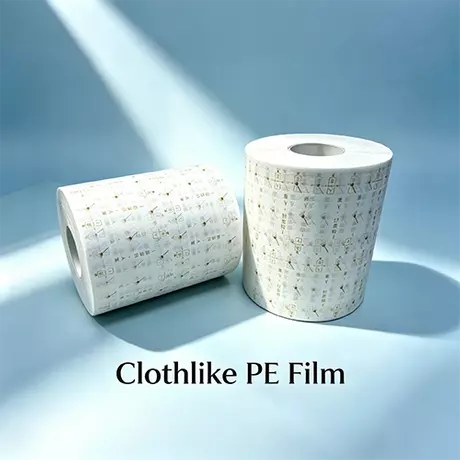
That pouch has an industry name: the individual wrapper, or pouch film. I supply the film that goes into these wrappers, so I spend a lot of time explaining to brand owners why the “eco wrapper” they want is harder than it looks. It keeps the pad dry in a humid bathroom, clean in a crowded handbag, and discreet on the walk to the office restroom. It is also, by almost every measure that matters to a waste system, close to unrecyclable.
Component | What it is | When it leaves the picture |
|---|---|---|
Pouch film | Outer sealed wrapper around each pad | Torn open before use |
Release paper | Paper protecting adhesive on back and wings | Peeled off right before application |
Backsheet | Liquid-proof bottom layer of the pad itself | Stays on during use |
Only the first one concerns us here—and it’s the one most likely to be discarded in a bathroom bin, mixed with a used pad, at which point no facility will attempt to recover it. The second, release paper, is a different material stream entirely; the third is part of the product, not packaging.
Pouch film is almost always polyethylene, usually a blend of LDPE and LLDPE. On paper, that‘s a recyclable resin. In practice, the material’s physical properties work against every step of recovery.
A typical wrapper runs around 20 microns—roughly a third of a human hair. We run cast film at that gauge because it seals fast and keeps the pad flat in the pack. But sorting equipment built for rigid containers handles films badly: lightweight sheets fly off conveyors and wrap around spinning parts. Facilities that do accept soft plastics want clean, dry, uniform material. A crumpled wrapper from someone‘s handbag meets none of those criteria.
Then consider where the wrapper is opened. A bathroom. A workplace restroom. A car. The moment it leaves the factory seal, it’s exposed to humidity and handling. Municipal recovery facilities sort for value; contaminated film is a cost, not a revenue stream.
And the used-pad problem is decisive. Once a pad is used, everything associated with it—wrapper included—belongs in residual waste. No reasonable consumer separates a clean wrapper from a used pad in a bathroom stall, and the quantities are far too small to justify a separate collection stream. The wrapper‘s fate is sealed the moment it enters the bathroom.
So even the “clean” wrappers—the ones from a damaged pack that never touched a pad—almost never get recycled. Most municipal programs don’t want them. The ones that accept soft plastics send them to processors who prefer commercial shrink wrap: uniform, clean, baled by the ton. A handful of consumer wrappers doesn‘t fit that business model.
Walk down any “natural” aisle and you’ll see pouches marketed as compostable. Many use polylactic acid, or PLA, made from corn starch or cassava. The material is genuinely bio-based, and under the right conditions it genuinely biodegrades.
Before going further, one clarification that matters: PE doesn’t biodegrade at all. PLA does, but only under specific conditions. This isn‘t a comparison of “more degradable” versus “less degradable.” It’s a comparison of “conditionally degradable” versus “not degradable in any relevant timeframe.”
The conditions PLA needs are industrial composting: 55–70°C, controlled humidity, and a microbial population cultivated to break down polymers. In that environment, PLA film can mineralize within 180 days. Research from Tsinghua University found that less than 0.01% of biodegradable waste ever reaches industrial composting facilities; the overwhelming majority goes to landfill or incineration. In seawater, PLA degradation is negligible—studies have measured rates below 1% over a year.
A PLA wrapper in landfill isn‘t just unhelpful. Sorted by mistake into a conventional plastic recycling stream, it contaminates the recycled resin. We have had customers ask us to quote PLA pouch film; the first question I ask back is whether their market has industrial composting collection at all. Most of the time, it doesn’t.
This is where marketing language gets slippery. Nonwoven describes how fibers are bonded—thermally, chemically, mechanically. It tells you nothing about what those fibers are.
The nonwoven most common in hygiene products is polypropylene. PP is a fossil-based plastic. It does not biodegrade in any meaningful timeframe. A PP nonwoven wrapper may use less plastic by weight than a PE film and may feel softer, but in a landfill it will still be there long after you are. Industry reporting on nonwoven agricultural films has confirmed the same problem: PP nonwoven marketed as “degradable” often just fragments into microplastics rather than mineralizing.
Biodegradable nonwovens do exist—PLA, PBAT, PHA, cellulosic blends can be formed into nonwoven webs. But they face the same composting infrastructure problem as PLA film, plus higher costs and real engineering challenges around moisture barrier and seal integrity. A wrapper that lets humidity through defeats its own purpose.
For anyone reading a package label: “nonwoven” does not mean “biodegradable.” It means “made from fibers.” The fibers determine everything.
Dimension | PLA pouch film | Nonwoven wrapper |
|---|---|---|
What it actually is | Bio-based polyester (polylactic acid) | A fiber-bonding process; material varies (PP, PET, PLA, PBAT, cellulose) |
Ideal degradation environment | Industrial composting: 55–70°C, high humidity, specific microbes | Depends on fiber: PP/PET nonwoven does not degrade; PLA/PBAT nonwoven needs industrial composting |
Degradation speed (industrial composting) | Can mineralize within 180 days | PLA-based nonwoven: roughly 3–6 months; PP nonwoven: does not degrade |
Natural environment (soil, seawater) | Extremely slow; seawater degradation below 1% per year | PP fragments into microplastics; PLA-based nonwoven similarly slow outside composting |
Home composting | Most PLA products degrade poorly | Only some biodegradable nonwovens perform acceptably |
Impact on recycling streams | Contaminates PE/PP recycling if mixed in | Theoretically plastic, but lightweight and easily contaminated; recovery rate low in practice |
The practical takeaway: PLA film has a clearer environmental story—if composting exists. Nonwoven wrappers may reduce plastic mass and feel better in hand, but “nonwoven” alone tells you nothing about end-of-life. A PP nonwoven wrapper is not meaningfully more degradable than a PE film. A PLA-based nonwoven is only as good as the composting infrastructure behind it.
If material substitution alone won’t solve this, what does?
Fewer wrappers. The single most effective intervention is not a different material. It‘s not having a wrapper at all. Bulk packaging—multiple pads in one sealed bag, or paper boxes with no individual film—eliminates the problem for most use cases. At home, the individual wrapper is a convenience, not a necessity. The trade-off is portability and discretion, which is exactly why the format persists.
Honest disposal guidance. A wrapper from an unopened pack sitting in a drawer is technically clean PE film; some soft-plastic drop-off points might take it. A wrapper opened in a bathroom and tossed in a bin is residual waste. Clear on-pack instructions would do more than aspirational “recyclable” claims most consumers can’t act on.
Paper, where it actually works. Recent patent activity shows renewed interest in paper-based wrappers for absorbent products. Paper has a genuine end-of-life advantage—if it isn’t laminated with plastic film that destroys both recyclability and compostability. The engineering challenge is real: paper tears unevenly, seals less reliably, needs treatment for moisture resistance. But for brands willing to invest, it‘s a more credible path than PLA in a landfill.
Compostable materials only where composting exists. A PLA wrapper makes sense in a market with curbside organics collection and industrial composting capacity. Without that, the material change is a gesture, not a solution.
In absolute terms, PLA is conditionally biodegradable and PE is not biodegradable at all. But “conditionally” is doing heavy lifting here. PLA requires industrial composting—55–70°C, controlled humidity, specific microbial activity—to degrade within a useful timeframe. PE does not biodegrade under any normal environmental condition. The practical difference in a landfill is smaller than the material labels suggest: both persist.
Most are not. The dominant nonwoven in hygiene products is polypropylene, a fossil-based plastic that does not biodegrade. Biodegradable nonwovens (PLA, PBAT, PHA, cellulose blends) exist, but they require industrial composting to degrade meaningfully. A package label saying “nonwoven” tells you the manufacturing method, not the fiber—and therefore not the end-of-life.
Technically, it is PE film, which is a recyclable resin. Practically, most municipal programs do not accept small, lightweight consumer films because sorting equipment handles them poorly and their mass-to-volume ratio makes collection uneconomical. Some soft-plastic drop-off points may accept clean PE film; check locally. A wrapper opened in a bathroom and placed in a bin with used products is residual waste.
Because the alternative—PE—offers no degradation story at all. PLA lets a brand make a bio-based claim, and in markets with composting infrastructure, that claim is real. In markets without it, the claim is aspirational at best. As a supplier, I ask customers whether their market has industrial composting collection before quoting PLA. Most of the time, the answer is no, and the conversation shifts to packaging reduction instead.
The pouch film is a masterclass in the gap between technical recyclability and practical recovery. It’s made of a recyclable resin, but it‘s too thin, too light, too easily contaminated, and too entangled with a product that is definitively not recyclable.
PLA offers biodegradability under conditions that almost never materialize. Nonwoven offers reduced plastic mass, usually in a fossil-based material that persists just as long.
The most defensible changes are the least glamorous: fewer wrappers through packaging redesign, clearer disposal instructions, and material choices tied to infrastructure that actually exists. The next time a brand asks me for a compostable wrapper quote, I’ll ask them the same question I always do: where will it actually end up? Until someone can answer that, the two-second tear produces waste that outlives everyone in the room.