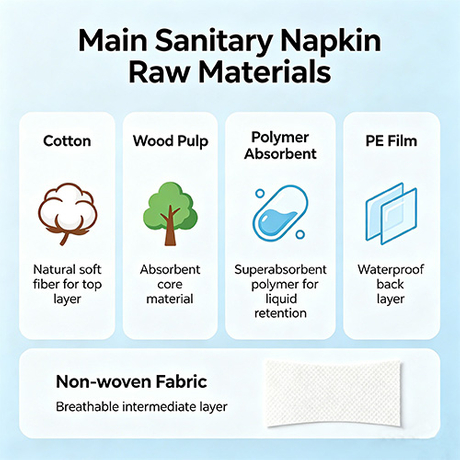
In feminine hygiene product development, the polyethylene (PE) film is often treated as a commodity input. It shouldn't be. The specification of PE film directly impacts end-user satisfaction, brand loyalty, regulatory compliance, and ultimately, your market position.
Most discussions about sanitary pads focus on surface softness or absorption speed. Rarely does the conversation turn to the PE film—the multi-functional material working across multiple components of the pad, from backsheet breathability to wrapper integrity.
This article breaks down where PE films perform critical functions, what technical specifications separate medical-grade hygiene films from industrial plastics, and how to evaluate film partners for your next product line.
Table of Contents
1. Hygiene-Grade PE Film: Engineered for Skin Contact, Not Industrial Use
The PE films used in feminine hygiene products are specialized medical/hygiene-grade polyethylene functional films—fundamentally different from standard packaging plastics.
Core Technical Differentiators
| Feature | Technical Implementation | Performance Outcome |
|---|---|---|
| Liquid Barrier + Breathability | Calcium carbonate (CaCO₃) filling at ~50% by weight + biaxial stretching (MDO) creates micropores (0.1–10μm) | Moisture vapor escapes; menstrual fluid remains contained. WVTR 1,500–3,500+ g/(m²·24h) per ASTM E96 |
| Biocompatibility | Virgin medical-grade/food-grade PE resins (LDPE/LLDPE/HDPE); food-contact compliant additives with established specific migration limits (SML) | Raw materials comply with FDA 21 CFR 177.1520, EU 10/2011, and REACH SVHC screening per EC 1907/2006 |
| Property Tuning | Density-specific PE selection per application; LLDPE for backsheet (softness + tear resistance); HDPE for structural layers | Optimized balance of softness, tensile strength, and breathability per component |
Critical distinction: Industrial PE films prioritize cost and basic barrier properties. Hygiene-grade films are engineered for prolonged skin contact, dynamic mechanical stress, and regulatory traceability. The microporous structure—created by stretching CaCO₃-filled PE—allows water vapor molecules (~0.4nm) to pass while blocking liquid water, achieving breathable waterproofing.
Explore our full range of hygiene-grade PE films for sanitary napkin applications.
2. Four Application Zones: One Material, Multiple Engineering Solutions
PE film is not limited to the backsheet. Each placement demands distinct material specifications.
2.1 Backsheet: The Core Barrier + Breathability System
The most recognized PE film application—and the most technically demanding. As the "bottom defense" of the pad, the backsheet must achieve the paradox of being impermeable to liquid yet permeable to vapor.
| Property | Typical Range | Engineering Rationale |
|---|---|---|
| Material | LLDPE (Linear Low-Density Polyethylene) | Balances softness with tear resistance during movement. Tensile strength: 12–30 N/25mm (MD) |
| WVTR | 1,500–3,500+ g/(m²·24h) | Enables "waterproof yet breathable" performance (ASTM E96, Method BW) |
| Hydrostatic Head | ≥50 cmH₂O; premium grades ≥80 cmH₂O | Minimum threshold for overnight/heavy-flow claims (AATCC 127 / ISO 811) |
| Function | Liquid barrier + vapor permeability | Prevents reverse, side, and back leakage while dissipating heat and humidity |
User benefit: Eliminates the "clammy, trapped" sensation that drives product switching and negative reviews. When combined with the absorbent core above, the backsheet ensures effective absorption and locking while preventing reverse leakage.

Hygiene-grade breathable PE film for sanitary napkin backsheet applications
2.2 Wings / Side Panels: Fixation + Leakage Prevention
Often overlooked, the wing structure relies on PE film engineering for dual performance. The construction typically uses thin PE film laminated with nonwoven, or embossed PE film for structural integrity.
- Mechanical function: Provides stable adhesive anchoring to undergarments without delamination
- Fluid management: Creates a 3D leakage barrier (raised edge structure) critical for high-mobility users
Key property: Flexural fatigue resistance—wings must maintain shape through thousands of body movements without cracking or detaching. The thinner gauge (12–18μm) ensures conformability without adding bulk.
2.3 Perforated Topsheet: The Dryness Engineering Layer
In premium ultra-thin pads and panty liners, PE film appears as the skin-contact surface through advanced perforation technology.
| Process | Specification | Performance Gain |
|---|---|---|
| Vacuum suction + laser perforation | Regular micro-apertures (50–500μm), pentagonal/hexagonal pattern | Rapid fluid acquisition + minimal surface retention |
| Comparative advantage vs. standard nonwoven | — | Improved surface dryness index under dynamic loading conditions |
Application: Ideal for ultra-thin products where bulk reduction cannot compromise fluid management speed. The perforated structure enables rapid strike-through while maintaining structural integrity.
2.4 Individual Wrapper Film: The First Line of Defense
The single-unit pouch is a high-performance barrier system, not mere packaging. It protects product integrity from factory to first use.
| Feature | Technical Solution | Commercial Value |
|---|---|---|
| Moisture / bacteria / odor barrier | High-barrier PE film, optionally with EVOH (Ethylene Vinyl Alcohol) co-extrusion layer | Extends shelf life; protects integrity in humid climates |
| Seal integrity | Heat-sealable PE formulation | Tamper-evident, hermetic closure |
| Brand presentation | Corona-treated surface | Printable without compromising tactile softness |
3. Five Core Functions: The Engineering Logic Behind Comfort
Regardless of placement, PE film performance converges on three user needs: comfort, leakage prevention, and hygiene. Here is how material properties translate to measurable product claims:
| Function | Technical Mechanism | Measurable Outcome |
|---|---|---|
| Leakage Barrier | High-density molecular structure + micropore design; hydrostatic head ≥50 cmH₂O (AATCC 127 / ISO 811) | Zero side/back leakage under dynamic load testing |
| Breathable Dryness | Micron-scale pores (0.1–10μm) + optimized WVTR 1,500–3,500+ g/(m²·24h); rapid vapor dissipation | Reduced humidity accumulation; lower skin irritation index |
| Hygienic Isolation | Physical barrier to dust, bacteria, and environmental contaminants | Materials evaluated per EN ISO 10993-5 (cytotoxicity) and EN ISO 10993-23 (irritation) for skin contact |
| Structural Stability | Density-graded PE selection per component; anti-deformation, anti-tear engineering | Zero pad displacement or component failure during 8-hour wear simulation |
| Soft Conformity | Softening additives + thin-gauge design (12–30μm); low bending stiffness per Gurley/Handle-O-Meter | Conformance to body contours; absence of foreign-body sensation |
4. Quality Benchmarks: What to Specify When Sourcing
Not all hygiene-grade PE films perform equally. Specify these hard metrics to filter suppliers and protect your brand:
| Criterion | Minimum Specification | Test Reference | Why It Matters |
|---|---|---|---|
| Raw Material Purity | 100% virgin hygiene-grade polyethylene; no recycled content; food-contact compliant additives with established SML | Resin CoA + batch traceability | Prevents contamination risks and regulatory rejection in export markets |
| Breathability | Backsheet WVTR ≥1,500 g/(m²·24h); topsheet air permeability ≥3,000 L/(m²·s) | ASTM E96 (Method BW) / ISO 9237 | Below this threshold, end-users experience measurable discomfort and brand switching |
| Leakage Resistance | Hydrostatic head ≥50 cmH₂O; premium grades ≥80 cmH₂O | AATCC 127 / ISO 811 | Minimum threshold for overnight/heavy-flow product claims |
| Skin-Feel Softness | Low bending stiffness for conformable drape | Gurley stiffness (TAPPI T543 / ASTM D6125) / Handle-O-Meter (ASTM D2923) | Critical for sensitive-skin product lines and premium positioning |
| Regulatory Compliance | FDA 21 CFR 177.1520 + EU 10/2011 + REACH SVHC screening (EC 1907/2006) | Third-party test reports | Required for US and EU market entry; SVHC currently at 242 substances |
5. Production Process: From Resin to Roll
Understanding the manufacturing process helps evaluate a supplier's capability to deliver consistent, specification-grade film.
Extrusion & Melting
Polyethylene raw material (virgin resin + CaCO₃ masterbatch + additives) is heated and melted in an extruder. For LLDPE backsheet films, typical extrusion temperatures range 160–200°C. Melt temperature and shear rate directly impact molecular orientation and final film clarity.
Film Formation
The molten PE is extruded through a die to form a tubular film (blown film) or flat sheet (cast film). Blown film is common for general packaging; cast film + machine-direction orientation (MDO) is preferred for breathable hygiene films as it enables precise control over micropore formation.
Cooling & Solidification
Rapid cooling locks in the amorphous structure. For breathable films, controlled cooling rates influence the interfacial adhesion between PE matrix and CaCO₃ particles—critical for subsequent stretching.
Machine-Direction Orientation (MDO)
The film is stretched 1.5–3.0× in the machine direction. This separates the PE matrix from CaCO₃ particles, creating micropores at the particle interfaces. Stretching ratio directly correlates with WVTR: higher stretch = larger pores = higher breathability, but lower hydrostatic head. The engineering challenge is optimizing this trade-off.
Surface Treatment & Winding
Corona treatment increases surface energy for printability or lamination. The film is then wound into master rolls with controlled tension to prevent telescoping or edge damage. Slitting to finished width occurs per customer specification.
Key process control point: Traction speed and stretching ratio are interdependent. Increasing traction speed raises MD tensile strength but reduces thickness; increasing blow-up ratio (for blown film) or transverse stretching (for tenter frame) enhances TD strength. For hygiene films, MDO parameters are proprietary and determine the final breathability/leakage balance.
6. Quality Control: Zero-Defect Delivery
As a dedicated developer and manufacturer of hygiene-grade PE films, our process controls target zero-defect delivery to feminine hygiene OEMs:
- In-line thickness monitoring: Beta-gauge or infrared sensors measure thickness across the web in real time. Automatic die adjustment maintains within ±5% tolerance. Any deviation triggers immediate process parameter correction.
- 100% batch testing for critical properties: Every production lot is tested for WVTR (ASTM E96), hydrostatic head (AATCC 127), tensile strength and elongation at break (ASTM D882), and basis weight.
- Microbiological safety: Surface bioburden testing per ISO 11737 or equivalent; total aerobic microbial count (TAMC) and total yeast/mold count (TYMC) monitored against internal specifications derived from GB 15979 / ISO 13485 principles.
- Application-specific formulation: Custom PE compound design per component—backsheet films optimized for breathability/leakage balance; wing films optimized for flexural endurance; topsheet films optimized for acquisition speed; wrapper films optimized for heat-seal strength and barrier.
We do not market features. We engineer specifications that your quality department can verify, your regulatory team can document, and your end-users can feel.
7. Development Trends: What Is Next for Hygiene PE Films
7.1 Thinner Films with Maintained Performance
Market demand for ultra-thin sanitary pads drives film gauge reduction without sacrificing barrier properties. Current R&D focuses on:
- Advanced CaCO₃ masterbatches with optimized particle size distribution (PSD) for thinner films with equivalent pore density
- Metallocene PE (mPE) resins offering superior toughness at lower gauges
- Downgauging from 18μm to 12–14μm while maintaining hydrostatic head ≥50 cmH₂O
7.2 Bio-Based and Circular Materials
Against the backdrop of increasing global environmental awareness, bio-based PE derived from sugarcane ethanol (e.g., Braskem I'm green™) offers identical chemical structure and performance to fossil-based PE with reduced carbon footprint. Key considerations:
- Drop-in compatibility: Bio-based PE (bio-PE) is chemically identical to conventional PE and requires no process or equipment changes
- Certification: Look for ISCC PLUS or RSB certification for mass-balance traceability
- End-of-life: Bio-PE is not biodegradable or compostable; it is recyclable within existing PE streams. Claims of "degradability" without ASTM D6400 or EN 13432 certification are misleading and may violate EU anti-greenwashing regulations
Regulatory caution: The EU has restricted oxo-degradable plastics (Directive 2019/904). Any "degradable" or "biodegradable" claim must be supported by certification to ASTM D6400, EN 13432, or ISO 17088. Uncertified claims expose brands to regulatory enforcement and reputational damage.
7.3 Enhanced Barrier Technologies
For premium and extended-wear products, multi-layer co-extrusion technologies are advancing:
- PE/tie/EVOH/tie/PE five-layer structures for ultra-high barrier wrapper films
- Water-based barrier coatings as alternatives to fluorochemicals (PFAS-free)
- Active packaging concepts: moisture scavenger layers to extend absorbent core shelf life
8. Material Science as a Competitive Advantage
PE film is lightweight, but its engineering impact is substantial. From backsheet to wrapper, from structural integrity to fluid management, it operates as the silent performance layer in every pad.
For feminine hygiene brands competing on comfort claims, regulatory compliance, and supply chain reliability, material specification is not a cost center—it is a quality commitment.
Moving forward, we continue to invest in film engineering that meets evolving global standards: tighter regulatory thresholds, higher sustainability requirements, and ever-rising user expectations for invisible comfort.
Ready to Specify Your Next PE Film?
Our technical team is available to review your specifications, recommend film grades, and provide samples for validation.
Engineered for performance. Trusted by brands worldwide.
Quanzhou Lonsun Corporation