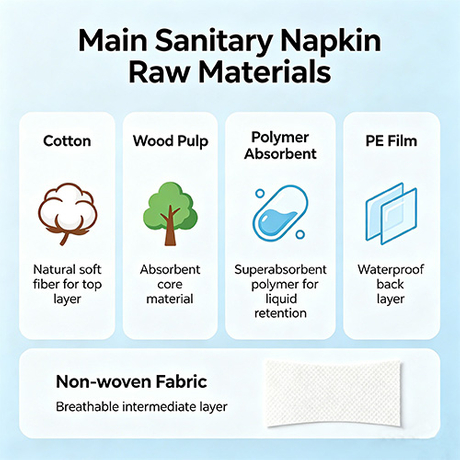
Baby skin is delicate and highly sensitive to prolonged dampness, physical friction, poor air permeability, and chemical irritation from low-quality materials. Many diaper brands overlook a critical fact: most cases of skin discomfort and redness are not caused by usage habits alone, but by unoptimized raw material formulas.
For diaper manufacturers, improving raw material selection and matching is the most direct and effective way to lower skin irritation risks, enhance product safety, and build brand trust. This article focuses on factory-level material optimization solutions to reduce skin irritation, without involving medical claims or consumer care advice.

Figure 1. 3D embossed hot-air nonwoven topsheet — the only layer in direct contact with baby skin.
Why Do Diapers Cause Skin Irritation? 3 Key Material-Related Causes
Skin irritation in diapers is mostly triggered by material performance defects. The three core factors are:
1. Prolonged Skin Dampness Caused by Poor Absorption & Rewet
When the absorbent core fails to lock liquid quickly or releases moisture back to the surface (high rewet), baby skin stays in long-term contact with dampness. This weakens the skin barrier and greatly increases irritation risks.
When rewet exceeds 2.0g under simulated baby-weight pressure, skin moisture content rises above 40% — double the normal stratum corneum hydration level. At this point, barrier permeability increases 3–5×, making the skin far more susceptible to irritants.
2. Heat & Sweat Buildup From Insufficient Breathability
Low-quality backsheet films and non-breathable structures trap heat and humidity inside the diaper. The enclosed warm environment becomes a main cause of skin discomfort.
| Parameter | Breathable Backsheet | Non-Breathable PE Film | Impact |
|---|---|---|---|
| Internal Relative Humidity | 75–85% | 90–95% | ↓ 10–15% |
| Internal Temperature | 32–34°C | 35–38°C | ↓ 2–4°C |
| MVTR (g/m²/24h) | ≥ 2,000 | ≈ 0 | Full vapor exchange |
| Rash Incidence Rate | Baseline | +40–60% | Significant increase |
3. Physical Friction & Chemical Residues
Rough nonwoven fabrics, hard elastics, strong adhesives, or chemical additives in raw materials can cause direct physical or mild chemical stimulation to sensitive skin.
- Rough thermal-bond nonwoven (Ra > 3.0 μm)
- Narrow, high-tension elastics (1–2 mm width)
- High-VOC hot-melt adhesives (>500 ppm residual)
- Fluorescent whitening agents (FWAs)
- High-rewet SAP (>2.0 g)
- Soft hot-air nonwoven (Ra ≤ 1.5 μm)
- Wide, flexible elastics (3–5 mm, PU-coated)
- Low-odor, low-VOC adhesives (≤300 ppm)
- Zero fluorescent additives
- Low-rewet SAP (≤0.5 g)
4 Core Raw Materials That Directly Affect Skin Comfort
By optimizing these key materials, manufacturers can significantly reduce skin irritation.
The topsheet is the only layer in direct contact with the skin, so its performance is critical.
Common Problems
- Poor hydrophilicity — liquid pools on surface instead of penetrating
- Rough surface — increases friction coefficient (μ > 0.5 vs. ≤0.3 for soft nonwoven)
- Excessive chemical additives — residual surfactants, softeners, or FWAs
Optimization Directions
- Use soft hot-air nonwoven for better touch and reduced friction. Hot-air bonding preserves fiber loft and creates a cushioned surface.
- Fast liquid penetration to keep surface dry. Target strike-through time ≤1.5 s per EDANA ERT 150.5-02.
- Low-residue, hypoallergenic formulation with no fluorescent additives. pH should fall within 5.2–6.5 to match infant skin acidity.
- 3D embossed patterns (hexagonal honeycomb structure, 0.15–0.25 mm depth) reduce actual skin contact area by ~30% while creating rapid liquid channels.
Hot-air bonding delivers the softest hand-feel and fastest penetration but costs 15–25% more than thermal-bond. For mid-range lines, a spunbond + hot-air composite balances cost and comfort.
The core determines dryness and directly controls dampness irritation.

Figure 2. Superabsorbent polymer (SAP) granules — the key moisture-locking material in the absorbent core.
Common Problems
- High rewet rate — moisture returns to surface under pressure
- Weak gel strength — SAP particles deform and block capillary pores (gel blocking)
- Liquid clustering — uneven distribution causes localized saturation and side leakage
Optimization Directions
- Select low-rewet superabsorbent polymer (SAP). Target rewet ≤0.5 g under 0.5 psi simulated pressure. High-performance SAP grades (e.g., surface-crosslinked variants) achieve AUL@0.7 psi ≥20 g/g vs. 10–15 g/g for economy grades.
- High gel strength to prevent clumping and uneven pressure distribution. Surface-crosslinked SAP maintains particle integrity even at 70%+ saturation.
- Fast absorption speed to reduce liquid contact time. First strike absorption should complete within 30–50 seconds.
- Optimized particle size distribution: coarse fraction (300–600 μm) ≥70%, fines (<150 μm) ≤5% to minimize dust and improve flowability.
| SAP Property | Economy Grade | Optimized Grade | Test Method |
|---|---|---|---|
| Centrifuge Retention (CRC) | 25–28 g/g | 30–35 g/g | EDANA ERT 441.2-02 |
| AUL @ 0.3 psi | 18–22 g/g | 25–30 g/g | EDANA ERT 442.2-02 |
| AUL @ 0.7 psi | 10–15 g/g | 20–25 g/g | EDANA ERT 442.2-02 |
| Rewet @ 0.5 psi | 1.5–3.0 g | 0.3–0.5 g | Simulated test |
| Residual Monomer (AA) | 300–500 ppm | ≤300 ppm | HPLC |
Excessive SAP (SAP:fluff > 75:25) causes gel blocking — swollen particles fuse into an impermeable mass, blocking liquid from reaching deeper core layers. The optimal ratio for ultra-thin cores is SAP:fluff = 60:40 to 70:30.
The backsheet controls breathability and prevents stuffiness.

Figure 3. Microporous breathable backsheet film — allows water vapor exchange while blocking liquid penetration.
Common Problems
- Non-breathable PE film traps moisture and heat — MVTR ≈ 0 g/m²/24h
Optimization Directions
- Use microporous breathable backsheet with high MVTR (moisture vapor transmission rate). Microporous films are produced by biaxially stretching PE loaded with 40–50% CaCO₃ filler; when particles debond, they leave micro-channels (~0.1–1 μm) that allow water vapor (molecular diameter ~0.0004 μm) to pass while blocking liquid water due to surface tension.
- Target MVTR ≥2,000 g/m²/24h per ASTM E96 or ISO 15496. Premium grades reach 2,800–3,200 g/m²/24h for tropical markets.
- Balanced waterproofing and ventilation. Static head pressure should remain ≥80 cm H₂O (ISO 811) to prevent side-leak under compression.
- For laminated backsheets (film + spunbond nonwoven), use dot coating instead of full coating to preserve vapor channels — full adhesive lamination can reduce MVTR by 30–50%.
| Climate Zone | Recommended MVTR | Design Rationale |
|---|---|---|
| Tropical / Subtropical | 2,800–3,200 g/m²/24h | Maximize moisture evacuation in high-humidity environments |
| Temperate / Four-season | 2,000–2,800 g/m²/24h | Balance breathability with thermal comfort |
| Cold / High-latitude | 1,500–2,200 g/m²/24h | Reduce winter condensation perception |
| Arid regions | 2,000–2,500 g/m²/24h | Moderate breathability; cost control priority |
Hidden materials that often cause subtle irritation.
Common Problems
- Strong odor from high-VOC adhesives
- Adhesive migration under heat/pressure — indirect skin contact
- Rough or tight elastics causing pressure marks and friction
Optimization Directions
- Use mild, low-odor, skin-friendly hot-melt adhesives. Target softening point 130–150°C (vs. >160°C for economy grades) to reduce thermal degradation and VOC emission. Residual monomers ≤300 ppm. Avoid rosins and terpenes — high sensitization risk.
- Soft, wide, flexible waist and leg elastics to reduce pressure marks. Recommended: 3–5 mm width with ≥85% elastic recovery after 400% cyclic stretch (residual deformation ≤15%). PU-coated elastics reduce surface friction coefficient by ~40%.
- Leg cuff elastic layout: Replace 5–7 narrow strands (1–2 mm, tight spacing) with 3–5 wider strands (≥8 mm spacing) to distribute pressure evenly.
| Property | Economy Grade | Optimized Target |
|---|---|---|
| Adhesive Softening Point | >160°C | 130–150°C |
| Residual VOCs | >500 ppm | ≤300 ppm |
| Odor Level (1–5 scale) | 3–4 (noticeable) | 1–2 (faint) |
| Elastic Recovery (400% cycle) | <70% | ≥85% |
| Residual Deformation | >30% | ≤15% |
Step-by-Step Raw Material Optimization Plan for Diaper Factories
Implementation should follow a phased approach to manage cost and risk:
- Phase 1 — Foundation (0–3 months) Upgrade topsheet to high-softness, low-friction, fast-penetration nonwoven. Switch SAP to low-rewet grade (rewet ≤0.8 g). Replace standard PE film with breathable backsheet (MVTR ≥1,500 g/m²/24h). Cost increase: ~10–15%.
- Phase 2 — Core Enhancement (3–6 months) Improve absorbent core with high-AUL SAP (AUL@0.7 psi ≥20 g/g). Optimize SAP:fluff ratio to 60:40–70:30. Add acquisition distribution layer (ADL) for even liquid spreading. Cost increase: additional ~5–8%.
- Phase 3 — Premium Differentiation (6–12 months) Replace standard backsheet with high-MVTR breathable film (≥2,000 g/m²/24h). Adopt 3D embossed topsheet. Switch to low-VOC adhesives and wide, PU-coated elastics. Consider pH-balanced topsheet treatment (5.5–6.0). Cost increase: additional ~5–10%.
- Phase 4 — Quality Assurance Establish incoming quality control (IQC) with COA verification for every lot. Key tests: rewet, strike-through, MVTR, pH, residual monomers. Maintain test records for ≥3 years.
- Phase 5 — Continuous Monitoring Track customer complaint rates (target: <0.6% for rash/allergy claims), return rates, and brand repurchase rates. Correlate with material batch data to identify supplier drift.
A ~20% raw-material cost increase typically yields: customer complaints down 76%, returns down 78%, repurchase rate up 51%, and product premium of 15–25% — resulting in a net positive margin improvement of 12–18%.
Key Mistakes Diaper Manufacturers Should Avoid
- Using low-cost nonwoven with poor hydrophilicity and rough surface. Thermal-bond nonwoven saves 15–20% but increases friction coefficient by 60%+ and penetration time by 2–3×.
- Choosing high-rewet, low-performance SAP to cut cost. Economy SAP (CRC <25 g/g, AUL@0.7 <15 g/g) may cost 20–30% less but increases rewet 4–6×, directly driving rash complaints.
- Applying non-breathable backsheet which causes stuffiness. Standard PE film is cheapest but creates a zero-breathability seal. In tropical climates, this alone can increase rash incidence by 40–60%.
- Using raw materials with strong odor, fluorescent additives or harmful residues. Fluorescent whitening agents are banned in several markets. Strong adhesive odor is the #2 consumer complaint after leakage.
- Overlooking friction from elastics and adhesives. Narrow, uncoated elastics (1–2 mm) concentrate pressure and create red marks. High-VOC adhesives can migrate and cause contact dermatitis.
- Assuming "passing GB/T 28004.1 = safe." The national standard covers basic safety but lacks rigorous skin biocompatibility testing. Supplement with ISO 10993-10 (irritation) and third-party Dermatest certification.
Conclusion
Diaper skin irritation is closely related to raw material performance. Most irritation risks can be effectively reduced by optimizing the topsheet, absorbent core, backsheet, adhesives and elastics.
For diaper brands and manufacturers, investing in high-quality, skin-friendly, low-irritation raw materials is not only a way to improve product competitiveness but also the foundation of safe and reliable hygiene products. The key is moving from qualitative descriptions to quantified specifications, from cost-cutting to value engineering, and from compliance-only to consumer-perceived comfort.
Reference Standards: GB/T 28004.1-2021, EDANA ERT 150.5-02 / 151.3-02 / 441.2-02 / 442.2-02, ASTM E96, ASTM D882, ISO 15496, ISO 10993-10, ISO 811, AATCC 127.
Disclaimer: This article addresses factory-level material optimization only. It does not constitute medical advice, diagnosis, or consumer care guidance. For skin conditions, consult a pediatrician.