Every day, the world produces roughly 380 million disposable diapers. These soft, absorbent, leak-proof little things go from raw materials to finished product in less than one second on the production line. How is that even possible? Let's step inside a modern diaper machine and see what really happens.
Part 1: From Cotton to "Magic Core": What's Actually in a Diaper?
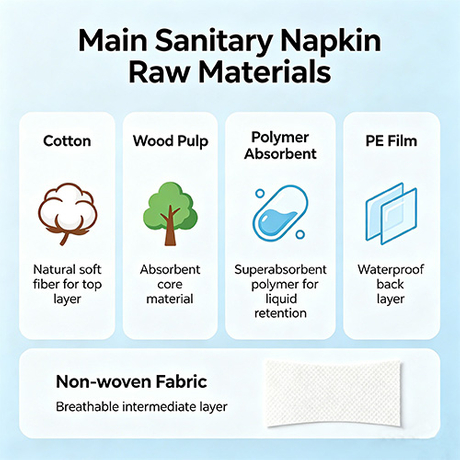
Before we enter the machine, let's meet its "ingredients." A diaper may look simple, but it's actually a precision-engineered sandwich of six or more layers:
| Layer | Material | Function | Fun Fact |
|---|---|---|---|
| Top Sheet | Spunbond/meltblown nonwoven | Wicks liquid away fast while keeping skin dry | Softer than silk—babies barely feel it |
| Acquisition & Distribution Layer (ADL) | Spunlace or airlaid nonwoven | Spreads urine across the whole core, preventing local bulging | Like a miniature highway system for liquids |
| Absorbent Core | Fluff pulp + Super Absorbent Polymer (SAP) | Locks away large volumes of liquid with zero rewet | SAP granules can absorb 300–500x their weight in liquid, turning into a jelly-like solid |
| Leg Cuff Elastics | Spandex threads | Hugs the thighs to prevent side leaks | Stretch and recover like thousands of tiny rubber bands |
| Waist Elastics | Elastic nonwoven or film | Lets the diaper stretch and move with the baby | Modern designs allow the waist to stretch 2–3x without losing shape |
| Back Sheet | PE film or composite nonwoven | Blocks liquid while letting vapor escape | Micropores let water vapor out but keep liquid in—that's the "breathable" secret |
| Hot-Melt Adhesive | Food-grade EVA hot melt | Bonds all layers together safely | Melts at ~120°C, odorless and non-toxic, meeting food-contact standards |
Part 2: A 7-Second Journey: A Diaper's Life on the Assembly Line
A standard diaper machine is a fully automated continuous production line. From raw material feed to finished stack, the entire journey takes just 7 seconds—with the actual forming, cutting, and bonding of each individual diaper happening in under one second at the die-cutting station. Here's how a diaper lives its "factory life":
Station 1: Unwinding & Tension Control
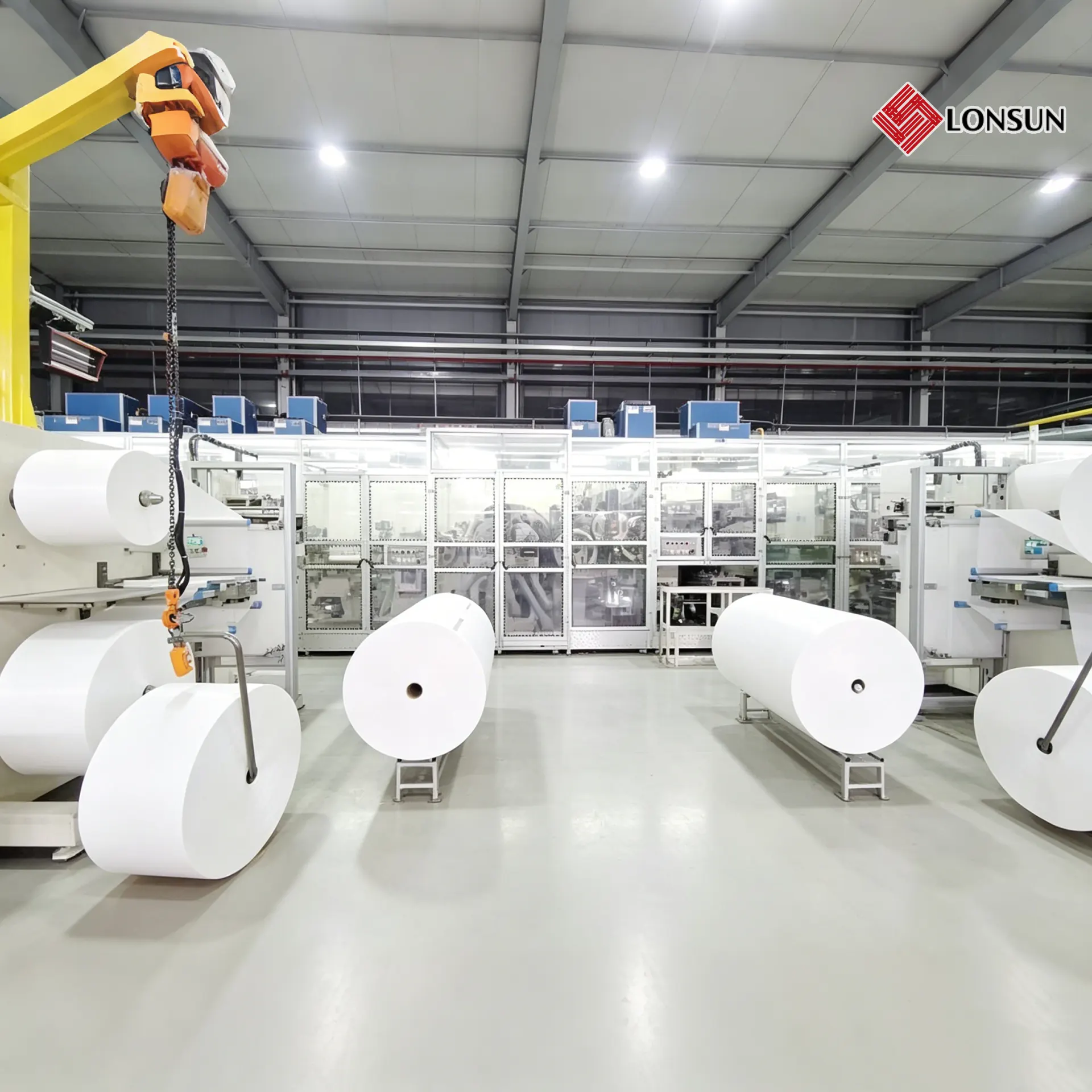
Picture a giant set of tape dispensers—rolls of nonwoven fabric, film, and elastic threads all unspooling simultaneously at speeds of tens of meters per second.
The challenge: If tension isn't perfectly controlled, materials wrinkle, drift off course, or snap. Modern machines use magnetic powder brakes + servo motors to maintain tension within ±0.1 millimeter.
Station 2: Core Forming—the Machine's Heart
This is where the "magic core" takes shape.
Fluff pulp and SAP are fed into a high-speed forming drum. Inside, a vacuum suction system pulls the mixture into an evenly thick pad.
Why is this so difficult?
- Fluff pulp is as light as cotton candy—it wants to float away
- SAP granules are incredibly fine (0.1–0.5 mm in diameter). Uneven distribution means a lopsided core, which means leaks
- Modern machines use airflow homogenization + inline weighing feedback, keeping core weight variance within ±3%
Station 3: Folding & Assembly—The Diaper Takes Shape
Now the diaper starts to look like, well, a diaper.
- Standing Leg Cuffs: Elastic threads are stretched and bonded to nonwoven edges, creating leak-proof "walls"
- Waistband Formation: Elastic materials are ultrasonically welded to the back sheet
- Three-Layer Marriage: The top sheet (skin contact) + absorbent core + back sheet (leak barrier) are aligned and bonded with sub-millimeter precision
Tolerance: Layer alignment must stay within <1 mm, or the baby gets chafing—or a puddle.
Station 4: Bonding & Sealing—No Sewing, No Glue (Well, Almost)
How do you hold it all together without stitching?
Method A: Hot-Melt Spray
- Glue guns fire hundreds of times per second in precise dot patterns
- Adhesive volume is controlled to the milligram—strong enough to hold, soft enough not to create hard lumps
Method B: Ultrasonic Welding
- High-frequency vibration (20–40 kHz) creates molecular friction heat, fusing materials instantly
- Zero chemical additives, more eco-friendly—commonly used for waistbands and side seams
Station 5: Die Cutting—The "Cookie Cutter" Stage
A rotary die cutter—essentially a giant cookie cutter—stamps the continuous material ribbon into individual diaper contours.
How fast?
- High-end full-servo models: 800–1,200 diapers per minute
- That's 13–20 diapers per second
- Faster than you can blink
Edge quality matters: rough edges chafe delicate skin; uneven cuts jam packaging equipment.
Station 6: Quality Inspection—The AI Eye That Never Blinks
Human eyes can't keep up, so AI vision systems take over:
| Inspection Item | Technology | When Defect Detected |
|---|---|---|
| Missing elastic thread | High-speed camera + image recognition | Automatic ejection |
| Insufficient glue | Infrared thermal imaging | Mark & eject |
| Core misalignment | X-ray / visual dual inspection | Automatic ejection |
| Stains / foreign objects | Multispectral imaging | Automatic ejection |
Accuracy: Modern systems achieve 99.5%+ detection rates with <0.1% false rejects.
Station 7: Stacking, Counting & Packaging
Approved diapers are vacuum-conveyed to a stacker, arranged in set counts (e.g., 30 per pack), and fed into a packaging machine for bagging or boxing.
From raw material to sealed bag: zero human contact, conducted in a controlled production environment with hygiene standards appropriate for skin-contact products.
Part 3: Three Personalities of Diaper Machines
Not all diaper machines are created equal. Based on automation and performance, they fall into three main categories:
| Type | Speed | Key Characteristics | Best For | Analogy |
|---|---|---|---|---|
| Semi-Automatic | Low to medium | Mechanical drive, requires manual feeding and adjustment | Startups, small-scale trials, custom orders | A manual car—cheap, simple, needs skill |
| Economic | Medium | Motor-driven with basic electrical control, partially automated | Growing factories, regional suppliers | An automatic sedan—reliable, cost-effective, easy to own |
| Full Servo | High (800–1,200 pcs/min) | Multi-axis independent servo motors + PLC intelligent control | Large factories, brand OEMs, export enterprises | A supercar—precise, blisteringly fast, intelligent |
Why Are Full Servo Machines So Fast?
Traditional machines use one main shaft driving all stations—like an old textile loom. One gear jams, the whole line stops.
Full servo machines give each critical station its own motor, orchestrated by a central computer (PLC):
- Size changeovers: one-button adjustment, completed in under 5 minutes
- If one station faults, others can keep running or stop independently
- 20–30% lower energy consumption, 15 dB quieter
Traditional vs. Full Servo: A Real-World Scenario
Let's put the difference into perspective with a typical factory scenario:
You start the size changeover. Mechanical cams need manual adjustment. Gears need swapping. Your senior mechanic spends 3–4 hours fine-tuning alignment. By the time you're running, you've lost half a shift. Halfway through the order, a gear wears down. The entire line stops for emergency maintenance. You deliver late. The client doesn't renew.
You press one button on the HMI screen. All 50+ servo axes automatically reposition in under 5 minutes. Production starts immediately. Mid-run, a minor vibration anomaly is detected on Station 4. The PLC isolates that station for inspection while the rest keep running. Maintenance fixes it during the next scheduled break. You deliver on time. The client doubles next year's order.
This is not a sales pitch—it's the daily reality in factories running both types of equipment. The initial investment gap is significant, but so is the difference in uptime, flexibility, and total cost of ownership over a 10-year lifecycle.
Part 4: The Hidden "Black Tech" Inside
1. Tension Control: Making "Floating" Materials Behave
Nonwoven fabric and film flutter like flags at high speeds. The machine uses dancer rollers + tension sensors + servo feedback in a closed-loop system to maintain perfect pull.
Analogy: It's like flying a kite—too slack and it falls, too tight and the string snaps. Tension control is the "intelligent hand" constantly adjusting.
2. Vision Inspection: A Quality Inspector 100x Faster Than Human Eyes
High-speed cameras capture thousands of frames per second, with AI algorithms analyzing each image in milliseconds.
How small a flaw can it catch?
- A single missing elastic thread (0.5 mm diameter)
- A glue dot shifted by 0.3 mm
- A core weight deviation of just 1 gram
3. Ultrasonic Welding: Molecular-Level Bonding Without Glue
High-frequency vibration raises the contact surface temperature above the melting point, allowing polymer molecules to intermingle and solidify as they cool.
Advantages:
- Zero chemical residue
- Uniform bond strength
- Ideal for medical-grade and sensitive-skin products
4. Modular Design: Upgrade Like LEGO
Modern machines split core functions into independent modules:
- Core forming module
- Elastic application module
- Folding & composite module
- Cutting module
Benefit: Want more speed? Swap in a faster cutting module. Need new functionality? Add a new composite unit. No need to rebuild the entire machine.
Part 5: The Global Standards Behind Every Machine
Since diapers touch infant skin and sensitive areas, the machines themselves must meet strict international regulations:
| Standard | What It Covers | In Plain English |
|---|---|---|
| CE Marking | EU machinery safety | "This machine won't bite, shock, or suddenly go rogue" |
| ISO 9001 | Quality management | "Every step from design to after-sales is documented and traceable" |
| FDA Compliance | US material safety | "Skin-contact materials won't release harmful substances" |
| IQ/OQ/PQ | Medical-grade validation | "Installation, operation, and long-term performance are rigorously tested" |
Part 6: The Future: Where Are Diaper Machines Headed?
1. Faster, Steadier, Quieter
- Target speeds: 1,500+ diapers per minute
- New material compatibility: biodegradable PLA nonwovens, bamboo fiber, and other eco-materials
2. Intelligence & Digitalization
- AI predictive maintenance: Sensors monitor bearing vibration and motor temperature, warning of failures 2 weeks ahead
- Digital twins: Simulate the entire machine on a computer—test new recipes without stopping production
- Remote AR support: An engineer on another continent guides on-site repairs through AR glasses
3. One Machine, Multiple Products
Same line, 30-minute changeover between:
- Baby diapers → Adult incontinence pants → Pull-up training pants
- Achieved by swapping modules and adjusting software parameters
4. Green Manufacturing
- 30–40% energy reduction
- 20% less adhesive (more precise spray control)
- Recyclable material compatibility, reduced plastic usage
5. Medical-Grade Cleanliness
- Cleanroom design (Class 100,000 or higher)
- Dust-proof structures
- Food-grade contact parts
Conclusion: The Hidden Technology in Every Diaper
Next time you pick up a diaper, take a closer look—
That soft top sheet is a triumph of air-through bonding technology;
Those invisible SAP granules are a miracle of polymer chemistry;
That snug elastic waistband is the result of precision mechanical and servo control;
That sub-one-second forming speed is the product of dozens of stations synchronized to the millisecond.
A diaper machine is a convergence of mechanical engineering, materials science, automation, and artificial intelligence. It is not merely a "diaper-making machine"—it is a testament to the precision and efficiency of modern manufacturing.
From a puff of cotton to a diaper that keeps a baby dry through the night, the warmth of technology is hidden in that journey of less than one second.
Appendix: You Might Also Wonder
Data Sources & References
- Global daily diaper production (380 million): Estimated based on industry reports from Euromonitor International and Grand View Research (2023–2024), accounting for both baby and adult diaper segments across all markets.
- SAP absorption capacity (300–500x): Technical specifications from major SAP manufacturers including BASF, Sumitomo Seika, and Nippon Shokubai product datasheets.
- Machine speed ranges (800–1,200 pcs/min): Manufacturer specifications from leading full servo machine producers including Fameccanica (Italy), Zuiko (Japan), and representative Chinese manufacturers.
- China market share (60–70% of mid-range machines): Industry analysis from China Nonwovens & Industrial Textiles Association (CNITA) and trade export data (2022–2024).
- Machine lifespan (10–15 years): Industry standard based on manufacturer warranty terms and maintenance guidelines from major OEMs.
- Energy and adhesive reduction figures: Comparative studies published in Nonwovens Industry magazine and technical papers from ITMA (International Textile Machinery Association) exhibitions.
- Certification standards (CE, ISO 9001, FDA, IQ/OQ/PQ): Official documentation from respective regulatory bodies and industry best practices for hygiene product manufacturing equipment.