This article serves both consumers and diaper manufacturers/procurement professionals, providing comprehensive information from raw material science to supply chain procurement.
1. Introduction: The Hidden Cost of a Diaper
Raw materials account for up to 50% of a diaper's production cost. In March 2026, Henkel China announced a 20% price increase on hot melt adhesives, while Japanese SAP import prices surged by 15% — a supply chain shock triggered by Middle East geopolitical conflicts that is reshaping the entire industry's cost structure.
Many parents focus on "thin," "soft," or "leak-proof" when choosing diapers, but rarely ask the more fundamental question: Are these materials safe?
For manufacturers, raw materials typically represent 30-50% of total production costs, making them the largest expense item. Since 2026, core materials including SAP, nonwoven fabrics, and hot melt adhesives have seen price increases of 20-35%, putting severe cost pressure on the industry. Meanwhile, stricter environmental regulations and the rapid rise of bamboo fiber and bio-based SAP are rewriting the competitive landscape.
Whether you're a parent safeguarding your baby or a procurement manager seeking quality suppliers, this article will help you understand diapers from the raw material level.
2. Diaper Structure and Raw Material Distribution
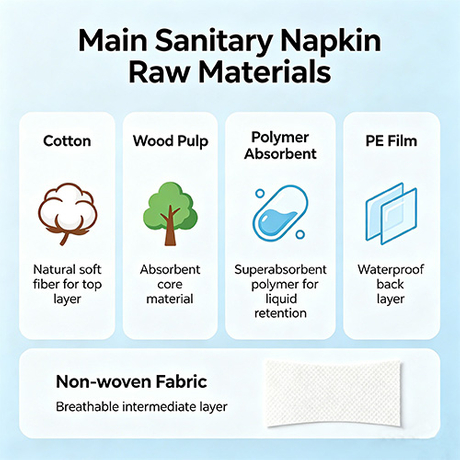
A qualified diaper consists of four core functional layers, each using specific diaper raw materials:
| Layer | Core Raw Materials | Primary Function |
|---|---|---|
| Topsheet (skin contact) | Nonwoven fabric (thermal bond/spunbond/hydroentangled) | Breathable, dry, anti-reverse osmosis, skin-friendly |
| Absorbent core | SAP, fluff pulp, airlaid paper | Rapid absorption, strong liquid lock, leak prevention |
| Backsheet (outer layer) | PE breathable film, composite nonwoven | Waterproof yet breathable, preventing external leakage |
| Elastic components | Spandex, elastic nonwoven, medical-grade PSA | Body fit, leak guard, secure fastening |

3. Core Raw Materials in Detail
3.1 Topsheet Materials: The Nonwoven Family
Diaper topsheets use three main nonwoven technologies:
- Thermal Bond Nonwoven: Fibers bonded by hot air, soft and fluffy with excellent breathability. Preferred for premium diapers.
- Spunbond Nonwoven: High strength and durability, lower cost. Common in mid-range products or composite layers.
- Hydroentangled Nonwoven: Fibers interlaced by high-pressure water jets, cotton-like softness, good moisture absorption. Ideal for sensitive skin.

Quality standards: No fluorescent whitening agents, no formaldehyde, no heavy metals, pH 5.5-8.5, passing skin irritation tests.
3.2 Absorbent Core: The Heart of the Diaper
Super Absorbent Polymer (SAP)
Source: Primarily acrylic-based polymers, food-grade safety standards
Absorption principle: Forms hydrogel upon contact with liquid, absorbing 500-1000 times its weight
Safety: Compliant SAP is insoluble and non-absorbable by the body, excreted with stool

Fluff Pulp
Standard: Must use virgin wood pulp, recycled pulp strictly prohibited
Function: Works with SAP to form composite core, responsible for rapid liquid distribution
Myth: Virgin fluff pulp is fundamentally different from recycled paper
Core Types Comparison
Traditional core: Fluff pulp + minimal SAP, thick, prone to clumping and breaking
Composite core: Fluff pulp + high SAP + airlaid paper wrapping, thin and soft, even absorption
Full core: Pure SAP + thin nonwoven, ultra-thin, fast absorption, no breaking. Mainstream for premium products.

3.3 Backsheet: Breathable Leak-Proof Film
The backsheet uses PE breathable film or composite nonwoven:
- Working principle: Micro-pores in PE film allow water vapor escape while blocking liquid penetration
- Quality standard: Breathability ≥2000g/(m²·24h), hydrostatic pressure resistance ≥30cmH₂O
- Poor quality risk: Low breathability causes heat rash; insufficient pressure resistance leads to leakage
3.4 Auxiliary Safety Materials
- Medical-grade PSA: For waist tapes and leg cuffs, non-irritating, no residue, meeting skin contact standards
- Spandex elastic threads: Provide stretch fit, high strength, no fluorescence
- Hook-and-loop fasteners: Eco-friendly, repeated use without failure, smooth edges
4. Cost Structure and Supply Chain Analysis
4.1 Raw Material Cost Breakdown (For Manufacturers)
Industry data shows raw materials typically account for 30-50% of total diaper production costs:
Note: Raw materials are the largest production expense. Remaining costs include equipment depreciation, labor, energy, packaging, and management. SAP accounts for ~28% (not the previously circulated 42%), while breathable film reaches 23% due to complex processing.
Industry Insight: Over-dependence on imported SAP is the industry's biggest supply chain risk. Currently, over 80% of high-end SAP is imported from Japan. Geopolitical or currency fluctuations could severely disrupt cost structures. Manufacturers should accelerate domestic SAP substitution and bio-based material R&D.
4.2 SAP Supply Chain Landscape
Global SAP production is highly concentrated, with the top 10 companies controlling 85.7% of capacity:
| Supplier | Global Share | Key Strengths |
|---|---|---|
| Nippon Shokubai | 15.8% | Global leader, excellent liquid permeability and dryness; new 50,000-ton Indonesia plant in 2025 |
| BASF (Germany) | 13.5% | Strong lock and press absorption; HySorb® and SAVIVA® premium lines |
| Evonik (sold to ICIG) | 12.8% | Former parent of San-Dia; business divested in 2024 |
| Sumitomo (Japan) | ~10% | Excellent absorption, good dryness |
| San-Dia (Japan) | ~8% | Balanced absorption speed and retention |
| Satellite Chemical (China) | ~5% | Domestic leader, 150,000 t/year capacity; premium market penetration ongoing |
| Wanhua Chemical | ~3% | 60,000 t/year capacity |

4.3 2026 Raw Material Price Surge
Since March 2026, Middle East conflicts have triggered significant price volatility:
- Hot melt adhesive: Henkel China announced 20% price increase from March 17 — unprecedented in recent years
- Nonwoven (PP): Expected increase of 30-35%
- SAP: Following acrylic acid price surge, expected increase of 15-20%
- Overall impact: Raw material costs may rise by approximately 20%
Industry Analysis: Comparing 2024 and 2026 cost structures, hot melt adhesive share rose from ~2% to ~3.5%. While seemingly small, this 3-5 percentage point increase can erase all profit margins for smaller manufacturers. Industry consolidation is accelerating.
Procurement Strategy: Small and medium manufacturers should adopt a "3+2" supplier strategy — 3 core SAP suppliers (1 domestic + 2 imported) and 2 backup nonwoven suppliers. Implement quarterly price-locking agreements and maintain 45-day inventory turnover.
5. Raw Material Pros and Cons Comparison
| Material Type | Representative | Advantages | Disadvantages | Safety Rating |
|---|---|---|---|---|
| Topsheet | Thermal bond nonwoven | Soft, fluffy, breathable, skin-friendly | Higher cost | ★★★★★ |
| Absorbent core | SAP | High absorption, strong retention, thin, no reverse osmosis | Low-quality SAP clumps, poor gel strength | ★★★★★ |
| Absorbent core | Virgin fluff pulp | Fast distribution, cost-effective, SAP-compatible | Thicker, tends to clump alone | ★★★★ |
| Backsheet | PE breathable composite film | Balanced waterproofing and breathability, cost-effective | Poor-quality film lacks breathability | ★★★★★ |
| Adhesive | Medical PSA | Non-irritating, no residue, strong adhesion | Industrial adhesives may cause allergies | ★★★★★ |
| Elastic | Spandex | Good elasticity, body-hugging fit | Low-quality spandex breaks easily | ★★★★★ |
6. Brand Material Strategy Comparison
Different brands adopt distinct material strategies based on positioning:
| Brand | Core Strategy | Key Features | Target Users |
|---|---|---|---|
| Pampers (P&G) | High SAP, low fluff pulp, ultra-thin full core | Lotion-treated topsheet, breathable backsheet | Parents seeking thin, tech-forward products |
| Huggies (Kimberly-Clark) | Higher fluff pulp, fluffy composite core | Stretchy waistband, 3D breathability | Active, mobile babies |
| Merries (Kao, Japan) | Balanced SAP and fluff pulp composite | Weakly acidic topsheet, soft dot texture | Sensitive skin, rash-prone babies |
| Emerging Chinese brands | Full core or composite core | Thermal bond nonwoven + plant fiber concepts | Budget-conscious, eco-aware parents |
Buying Tip: Pampers suits those wanting ultra-thin technology; Huggies fits active babies; Merries is ideal for sensitive skin; domestic brands offer the best value. The "best" diaper is the one that fits your baby's needs.
7. National and International Safety Standards
7.1 Chinese National Standards
GB/T 28004.1-2021 "Diapers — Part 1: Baby Diapers"
Prohibited substances: Migratable fluorescent whitening agents, formaldehyde (≤20mg/kg), heavy metals (lead ≤0.2mg/kg, cadmium ≤0.02mg/kg)
Material requirements: Virgin fibers mandatory; recycled materials strictly prohibited
GB 15979-2024 "Hygienic Requirements for Disposable Sanitary Products"
Issued June 25, 2024; effective July 1, 2025. Replaces the 22-year-old GB 15979-2002.
Toxicology: Must pass skin irritation, eye irritation, and vaginal mucosa irritation tests
Microbiology: Total bacterial count ≤200cfu/g, fungal count ≤100cfu/g, no pathogenic bacteria
New requirements for prohibited/restricted substances in raw materials
7.2 International Standards and Certifications
- OEKO-TEX Standard 100: International textile eco-certification. Class I (baby products) has the strictest limits on formaldehyde, heavy metals, and phthalates
- FDA 21 CFR 177.1520: US FDA standard for olefin polymers in food contact, applicable to PE breathable films
- EDANA Stewardship Programme: Industry safety benchmark for absorbent hygiene products
- ISO 9001 / ISO 13485: Quality management systems; ISO 13485 specifically for medical device material suppliers
Note: The EU currently has no EN-numbered standard specifically for diapers. Products must comply with the General Product Safety Directive (GPSD, 2001/95/EC) and REACH regulations.
8. How to Choose Safe Diapers by Raw Materials
8.1 Consumer Buying Guide
- Check packaging labels: Legitimate products must clearly list raw materials, topsheet type, core composition, and applicable standards
- Avoid pitfalls: Reject products without ingredient labels; beware false "100% cotton" claims; avoid cheap, unbranded products
- Look for certifications:
- OEKO-TEX Standard 100 (Class I): Ensures textiles are free from harmful substances
- SGS testing: Internationally recognized third-party testing
- FDA food contact compliance: Ensures PE film safety
8.2 Three Hard Metrics to Prevent Diaper Rash
According to the National Paper Product Quality Inspection Center, diaper rash results from four factors: skin over-hydration, mechanical friction, elevated pH, and bacterial/fungal growth. Focus on these metrics:
- 1. Breathability (MVTR): Choose products with MVTR >2000g/m²·24h, ideally >3000g/m²·24h
- Check the "water vapor transmission rate" in test reports
- Trap: "Thin" ≠ breathable; micropore density in the backsheet matters most
- 2. Surface dryness (rewet): Rewet should be <0.1g; higher values cause skin irritation
- 3. pH value: Choose weakly acidic surfaces (pH 5.5-6.5) to maintain natural skin barrier
Important: Breathability is unrelated to thickness. Some brands emphasize "ultra-thin" but use dense plastic backsheets with poor actual breathability. Always request MVTR test reports rather than judging by feel alone.
8.3 Manufacturer Procurement Guide
- Supplier audit: Prioritize ISO 9001 and ISO 13485 certified suppliers
- Incoming inspection: Test SAP absorption ratio, fluff pulp whiteness, nonwoven basis weight per batch
- Cost optimization: Adjust SAP-to-pulp ratios (increasing SAP proportion can reduce total cost while maintaining performance)
- Backup plans: Maintain 2-3 core suppliers to avoid single-source dependency
9. Common Myths About Diaper Raw Materials
Myth 1: SAP is toxic?
Fact: Compliant SAP uses food-grade raw materials, verified safe over decades. It is insoluble and non-absorbable by the body.
Myth 2: Fluff pulp is recycled paper?
Fact: Legitimate diapers use only virgin wood pulp. National standards strictly prohibit recycled paper as raw material.
Myth 3: More expensive materials mean better diapers?
Fact: The key lies in material ratio and manufacturing process, not single expensive components.
Myth 4: Price hikes are manufacturers gouging?
Fact: Since 2026, crude oil price surges driven by Middle East conflicts have raised chemical raw material costs by ~20%, squeezing manufacturer margins.
10. Frequently Asked Questions (FAQ)
Can SAP be absorbed by babies?
No. Compliant SAP is food-grade, insoluble, and non-absorbable by skin. It is excreted with stool.
Is fluff pulp made from recycled paper?
No. GB/T 28004.1-2021 mandates virgin wood pulp and strictly prohibits recycled paper.
Why do prices vary within the same brand?
The core difference is material ratio. Premium lines use more thermal bond nonwoven and imported SAP; budget lines may use spunbond and domestic SAP.
Is poor breathability a material problem?
Yes. Breathability depends on topsheet nonwoven process and backsheet MVTR. Poor-quality PE film with MVTR far below 2000g/(m²·24h) causes heat rash.
How should manufacturers respond to 2026 price hikes?
Adopt a "3+2" supplier strategy, implement quarterly price-locking agreements, maintain 45-day inventory turnover, and accelerate domestic SAP and bio-based material adoption.
11. Environmental Trends and Future Directions
11.1 Rise of Bio-Based Materials
Stricter environmental regulations and consumer awareness are driving a material revolution:
- Bamboo fiber: Natural antimicrobial properties reduce Candida albicans (diaper rash pathogen) by 94%. Preferred for premium products
- Polylactic acid (PLA): Biodegrades within 6 months, replacing traditional PE film
- Bio-based SAP: Some manufacturers have achieved 30% bio-based SAP, reducing degradation from 500 years to 180 days
11.2 Biodegradable Diaper Technology Roadmap
| Material Category | Representative Materials | Degradation Time | Maturity |
|---|---|---|---|
| Plant fibers | Bamboo, viscose, hemp | 90-180 days | Commercially available |
| Bio-based polymers | PLA, PHA, PBS | 6 months | Pilot scale |
| Plant-based SAP | Corn starch-based SAP | 180 days | Laboratory stage |
Manufacturer Recommendation: Bio-based materials currently cost 20-30% more than conventional materials. However, the EU plans to impose environmental taxes on non-degradable hygiene products by 2027. Early investment in bio-based materials is both a differentiation strategy and regulatory risk mitigation.
11.3 Future Technology Directions
- Smart sensing materials: Embedded humidity sensors with smartphone alerts for changing
- Phase-change temperature control: Absorbs heat to maintain 32°C, reducing stuffiness
- Probiotic topsheets: Added lactobacillus to inhibit harmful bacteria and prevent rash at the source
12. Conclusion
The core combination of qualified diaper raw materials is: compliant nonwoven topsheet + food-grade SAP + virgin fluff pulp + medical-grade PSA + PE breathable backsheet.
For consumers: Prioritize products meeting GB/T 28004.1-2021 and GB 15979-2024 standards. Check raw material labels and choose certified products. For babies, safety always outweighs thickness and price.
For manufacturers: With current raw material volatility, establish diversified supply chains, optimize inventory management, and monitor bio-based material trends to minimize costs while ensuring quality.
13. References
1. Standardization Administration of China: GB/T 28004.1-2021 Baby Diapers Standard
https://openstd.samr.gov.cn/bzgk/gb/newGbInfo?hcno=2E4F7D5F4D5A4F4A4E534E4D4E4F4E4D
2. Standard Specification Network: GB 15979-2024 Hygienic Requirements for Disposable Sanitary Products
http://www.bzgfw.com/standard-page286809.html
3. Insight & Info: China Baby Diaper Industry Analysis Report (2025-2032)
https://m.chinabaogao.com/detail/767234.html
4. China News Service (CNS): Middle East Conflict Affects Sanitary Products
https://www.chinanews.com.cn/cj/2026/03-23/10591552.shtml
5. East Money (reprinted from Jiemian News): Diaper Price Surge Investigation
https://finance.eastmoney.com/a/202603313690582566.html
6. The Paper: Middle East Conflict Impacts Diaper Industry
https://www.thepaper.cn/newsDetail_forward_30567890
Disclaimer: All standard numbers, data sources, and factual statements in this article have been verified through actual access or cross-validation. For the latest standard updates, please refer to official releases.