Table of Contents
What Is a Sanitary Pad, Really?
Every day, roughly 800 million people worldwide are menstruating. For most of them, the sanitary pad is a daily necessity — used, discarded, rarely thought about twice. But that thin, soft rectangle is actually a triumph of materials science, mechanical engineering, and fluid dynamics.
At its core, a sanitary pad has one job: absorb menstrual blood, prevent leaks, and keep the wearer dry. It looks simple — a pad with two adhesive strips — but modern pads are precision-engineered multilayer products. And the machines that make them? They are among the most sophisticated pieces of consumer-goods automation on Earth.

Different manufacturers categorize layers slightly differently. This diagram shows a 10-layer breakdown including optional features like the anion chip (layer ③) and two core options: traditional fluff pulp (Option A) and ultra-thin air-laid paper (Option B).
The Anatomy of a Pad: 7 Layers Explained
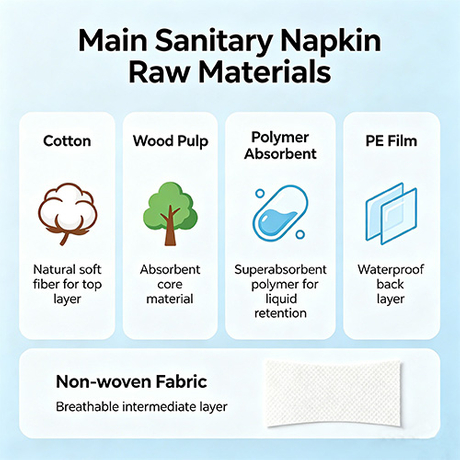
Slice a modern sanitary pad crosswise, and you will find a "sandwich" of materials — each with a specific job. The production line handles all seven simultaneously, aligning them with sub-millimeter precision.
| Layer | Material | Function | The Science |
|---|---|---|---|
| Top sheet | Hydrophilic non-woven fabric | Wicks fluid quickly, keeps surface dry | Capillary action: liquid spreads along fiber surfaces |
| Acquisition layer | Fluffy non-woven | Distributes fluid evenly to the core | Gradient density design: fluid flows from high to low density |
| Absorbent core | Fluff pulp + SAP | Absorbs and locks in liquid | SAP (Super Absorbent Polymer) swells on contact with water; 1 gram absorbs 100–1,000× its weight in deionized water |
| Wrap sheet | Thin non-woven | Holds the core together, prevents fiber shedding | Thermal bonding maintains core integrity |
| Back sheet | Breathable PE film | Waterproof yet air-permeable | Microporous structure: water vapor passes through; liquid water is blocked |
| Adhesive | Hot-melt pressure-sensitive glue | Attaches pad to underwear | Tacky at room temperature; peels without residue |
| Release liner | Silicone-coated paper | Protects adhesive before use | Silicone lowers surface tension; glue does not stick to paper |
The 8-Step Manufacturing Process
A modern sanitary pad line is a non-stop conveyor — raw materials enter one end, finished pads exit the other. A PLC (Programmable Logic Controller) and servo motors govern every motion with robotic precision.
Massive rolls of raw material — up to a meter in diameter — are loaded onto unwinding stations. Tension sensors monitor the feed in real time: too tight, and the material snaps; too loose, and it wrinkles. It is like flying a kite — the line must stay perfectly taut.
Wood pulp fibers are opened by airflow and blended with SAP powder (typically a 7:3 to 5:5 pulp-to-SAP ratio). The mixture is then molded into a uniform core. This is the most critical step — core uniformity directly determines absorbency.
The top sheet, core, back film, and side-guard materials are stacked and bonded with hot-melt adhesive. The glue application is exquisitely controlled — too much makes the pad stiff; too little causes delamination. Modern machines use spiral spray technology, distributing glue in a helical pattern that is both strong and soft.
Pad edges are sealed by ultrasonic welding — high-frequency vibrations (typically ~20 kHz) cause plastic molecules to rub against each other, generating heat that fuses the layers instantly. No needles, no thread, no holes: a perfect seal. Embossing rollers then press decorative patterns onto the surface, which also increases liquid diffusion area.
The machine cuts wings and body contours according to preset shapes — daytime, overnight, ultra-long, maternity. A rotary blade slices hundreds of times per minute with sub-millimeter precision.
Each cut pad is automatically folded into a tri-fold or Z-fold for compact packaging. The folding mechanism works like mechanical hands, completing one fold in 0.1 seconds.
High-speed cameras, metal detectors, and thickness sensors "examine" every single pad. If a foreign object, uneven thickness, or shape anomaly is detected, a pneumatic blast ejects the defective pad in milliseconds. Modern detection rates approach 99%.
Approved pads are individually wrapped (to prevent contamination), then counted into packs of 10, 20, or 30, boxed, labeled, and sealed. From raw material to finished product: under 3 minutes.

A full-servo high-speed sanitary pad production line in a clean-room environment. Raw material rolls feed in from the right; the entire processing area is enclosed in glass to maintain hygiene standards.
What Happens Inside a SAP Molecule?
SAP (Super Absorbent Polymer) is not a single substance but a family of cross-linked polymers, most commonly derived from acrylic acid and sodium hydroxide. Through a process called polymerization, these monomers link into long chains — imagine a three-dimensional fishing net where each knot is a cross-link.
The key to SAP's power lies in two structural features:
- Hydrophilic groups — Carboxylate ions (-COO⁻Na⁺) along the polymer chains attract water molecules like magnets
- Cross-linked network — Chemical bridges between chains prevent the polymer from dissolving, so it swells into a gel instead of disappearing into solution
The Absorption Mechanism: Osmosis at Work
When a SAP granule meets liquid, three things happen in rapid sequence:
Phase 1: Hydration (Milliseconds)
Water molecules are drawn into the polymer network through capillary action, filling the spaces between chains. The hydrophilic groups form hydrogen bonds with water, creating a concentration gradient.
Phase 2: Swelling (Seconds to Minutes)
Sodium ions (Na⁺) inside the polymer network create an osmotic pressure difference. Water rushes in to dilute the ion concentration, causing the polymer chains to uncoil and expand. A single granule can swell to 100–1,000 times its original volume in deionized water.
Phase 3: Gel Lock (Minutes)
The cross-linked structure acts like a molecular cage — water is trapped even under pressure. This is why a saturated SAP gel feels squishy but does not leak when squeezed.
Why Real-World Performance Differs from Lab Numbers
That "300× absorption" figure you see in marketing is measured in deionized water — pure H₂O with no dissolved substances. But menstrual fluid is not pure water. It contains:
- Proteins (clotting factors, enzymes)
- Electrolytes (sodium, potassium, chloride)
- Cellular debris (endometrial tissue, blood cells)
- Mucus (viscous glycoproteins)
These components compete with the polymer for water molecules and physically block polymer chain expansion. In practice, SAP absorbs 30–60 times its weight in menstrual fluid — still extraordinary, but far below the headline "300×" number.
The Chemistry of "Locking"
Once absorbed, the water is not merely stored — it is chemically bound. The carboxylate groups form strong hydrogen bonds with water molecules, creating a hydrogel network. Even under pressure (say, from sitting or walking), the gel retains liquid because:
- The cross-links prevent the polymer from dissolving
- The osmotic pressure inside the gel balances external pressure
- The viscosity of the gel slows fluid migration
From Lab to Pad: Engineering the Granule
Not all SAP is created equal. Manufacturers tune three variables during synthesis:
| Variable | Effect | Trade-off |
|---|---|---|
| Cross-link density | Higher density = stronger gel, less swelling | Too high = brittle, low absorbency |
| Monomer concentration | Higher = more hydrophilic groups | Too high = residual monomers (safety concern) |
| Particle size | Smaller particles = faster absorption | Too small = dusting, respiratory hazard |
Premium diaper and pad SAP uses surface-crosslinked granules — the outer shell is more densely cross-linked than the core. This creates a "fast-absorbing shell" that wicks liquid inward, while the softer core provides total capacity.
The Environmental Catch
SAP is a petroleum-derived polymer (acrylic acid comes from propylene, a byproduct of oil refining). Once in a landfill, the cross-linked structure resists bacterial decomposition. A used pad's SAP gel can persist for decades — the same property that makes it useful in a pad makes it problematic in the environment.
Researchers are exploring bio-based alternatives:
- Starch-grafted SAP: Mixing corn starch with acrylic acid reduces petroleum content
- Cellulose-based hydrogels: Derived from wood pulp, more biodegradable but lower absorbency
- Protein-based SAPs: Using waste proteins from food processing (still experimental)
None yet match petroleum SAP's performance-to-cost ratio, which is why it remains dominant in the industry.
A Brief History of Pad-Making Machines
The industrial production of sanitary pads did not happen overnight. It took a century to evolve from handmade rags to AI-driven automation.
Women used reusable cloth pads, sewn by hand at home. No industrial production existed.
Kotex launched the first disposable pad, made from cellulose cotton. Production was largely manual, output minimal.
Self-adhesive strips replaced pins and belts. Machines became semi-automatic, but speeds hovered around 50 pads per minute.
SAP polymers entered the market, revolutionizing absorbency. Machines grew more integrated, reaching 200–400 pads per minute.
Full servo motors replaced mechanical drives. Speeds broke 800 pads per minute. PLC control enabled precision tuning.
AI vision inspection, IoT monitoring, and flexible manufacturing. One machine can now switch between daytime, overnight, and panty liner specs in minutes.
How One Machine Can Change Lives
A sanitary pad machine is not merely industrial equipment — it is public health infrastructure.
The Story of a Small Machine in Rural India
In remote Indian villages, a compact pad machine (30–120 pads per minute) can:
- Create jobs: Employ 5–10 local women to operate and maintain it
- Cut costs: Locally made pads are 50% cheaper than imported brands
- Improve health: Produce ~100,000 pads per month, serving 3,000 women
- Break taboos: Transform menstruation from "shameful secret" into "openly discussed local industry"
The film Pad Man (2018) was inspired by exactly this kind of real-world story.
A Global Health Imperative
The United Nations recognizes Menstrual Hygiene Management (MHM) as a key Sustainable Development Goal indicator. The World Bank estimates that roughly 500 million women worldwide still lack access to safe menstrual products. Pad-making machines — especially small, affordable models — are one of the most effective tools for closing that gap.
The Environmental Dilemma
For all the good they do, disposable pads carry a hidden environmental cost.
⚠️ The Hidden Environmental Cost
- Plastic burden: One pad contains approximately 2–3 grams of plastic (PE film, adhesive, packaging). In nature, that plastic takes 500–800 years to degrade.
- Massive waste: Globally, pads generate roughly 200,000 tons of waste annually — equivalent to 20,000 truckloads.
- Incineration challenges: Because pads contain plastic and bodily fluids, they are difficult to burn safely. Landfill remains the dominant disposal method.
- Microplastics: As pads slowly break down, they release microplastic particles into soil and water systems.
Signs of Change
- Biodegradable materials: PLA (corn-starch-based) films replacing PE; organic cotton substituting wood pulp
- Reusable alternatives: Menstrual cups and period underwear gaining popularity (though these require entirely different production lines)
- Plastic-free pads: All-plant-fiber construction with compostable packaging, degrading within 6 months
- Recycling experiments: A few companies are piloting processes to separate plastic and organic fibers from used pads
Frequently Asked Questions
Sources & Further Reading
- World Bank. (2026). Menstrual Hygiene Day 2026: 500 Million Left Behind. Retrieved from https://www.worldbank.org/
- WHO. (2024). Guidelines on Menstrual Health and Hygiene. Geneva: WHO Press.
- Standardization Administration of the PRC. (2018). GB/T 8939-2018: Sanitary Absorbent Pads (Panty Liner). Beijing: Standards Press of China.
- Standardization Administration of the PRC. (2024). GB/T 22875: Superabsorbent Polymer for Sanitary Towel. Beijing: Standards Press of China.
- Carbon Literacy Project. (2025). Environmenstrual Justice and the Carbon Cost of Period Products. Retrieved from https://carbonliteracy.com/
- Nuoer Polymer. (2026). Odor Control Super Absorbent Polymer Versus Standard SAP Performance. Technical White Paper.
- Gelsap. (2025). How Super Absorbent Polymers Work. Retrieved from https://gelsap.com/
- WomenGMachines. (2025). What is the Production Capacity of a Sanitary Pad Making Machine?
- Niceday Global. (2026). Women Napkins Factory – Sanitary Pads Production Process.
- Grand View Research. (2025). Sanitary Napkin Market Size, Share & Trends Analysis Report.