Home
Home | About Us | Advantages | Blogs | Contact Us


- All
- Product Name
- Product Keyword
- Product Model
- Product Summary
- Product Description
- Multi Field Search
Views: 0 Author: Judy Chen Publish Time: 2026-04-28 Origin: Quanzhou Lonsun Corporation


Disposable underpads have become essential products in medical care, elderly nursing, pet care, and household hygiene, driving a steady global demand for high-quality underpad manufacturing materials. As a professional supplier of raw materials for disposable hygiene products, Lonsun has compiled this comprehensive guide to help underpad manufacturers, factory purchasers, and OEM producers understand core raw material structures, performance standards, matching schemes, and purchasing considerations. This article covers all key raw materials used in disposable underpads, their features, application scenarios, and how to choose suitable materials to improve product quality and reduce production costs.
According to industry research data, the global disposable underpad market is expected to grow at a CAGR of 6.2% from 2024 to 2030, with major demand coming from hospitals, nursing homes, home care institutions, and pet product manufacturers. This growth directly drives the rigid demand for stable, high-performance underpad raw materials.
High-quality finished underpads depend entirely on the selection of raw materials. Inferior materials lead to problems such as poor water absorption, side leakage, back seepage, and skin irritation, while premium raw materials help manufacturers produce competitive products and expand international markets (EU, North America, Southeast Asia, etc.). For underpad producers, choosing the right raw material supplier is the first step to ensuring product qualification and market competitiveness.

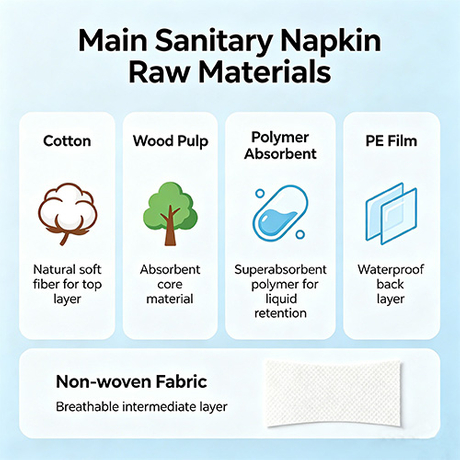
A standard disposable underpad consists of five key layers, each requiring specific raw materials to achieve performance balance. Below is a detailed breakdown of each layer and its matching raw materials:
The top layer directly contacts the skin, requiring softness, breathability, and rapid liquid penetration.
Medical-grade underpads use SMS non-woven fabric for better bacterial barrier performance; economy-grade household underpads use standard PP spunbond non-woven fabric to control costs.
The absorbent core is the core functional layer, responsible for liquid absorption and locking.
This layer guides liquid to spread evenly and prevents SAP agglomeration.
The bottom layer prevents liquid leakage and isolates contaminants.
Features: Waterproof, anti-penetration, tear-resistant
Medical and elderly care products use breathable PE film to reduce stuffiness; low-cost household products use ordinary PE film.
Used to bond each layer of materials and fix the underpad shape.

For underpad manufacturers, raw material selection directly affects product certification, export compliance, and production stability. Lonsun summarizes the core selection criteria:
Raw materials must meet global hygiene and safety standards to support finished product exports:
Lonsun's underpad raw materials all pass relevant third-party testing, suitable for medical and civilian grade underpad production.
Large-scale underpad production requires continuous raw material supply. Stable suppliers can reduce production interruptions and optimize overall costs through bulk wholesale.
Many finished product quality issues stem from unqualified raw materials:
Choosing professional raw materials like those supplied by Lonsun can effectively avoid these problems and improve the qualified rate of finished products.
Lonsun focuses on the R&D, production, and wholesale of raw materials for disposable hygiene products, providing one-stop raw material solutions for disposable underpad manufacturers worldwide.
If you are a disposable underpad manufacturer looking for stable, high-quality raw materials, please contact Lonsun for: