Hot and humid weather creates one of the most underestimated challenges for people who menstruate. When ambient temperatures exceed 30°C (86°F) with relative humidity above 70%, the perineal skin is subjected to an occlusive microenvironment: trapped sweat, menstrual fluid, and friction combine to raise local skin surface temperature and create conditions ripe for irritation.
The clinical consequences are well-documented. Research on menstrual hygiene in tropical regions has found that a majority of menstruating individuals in such climates report dermatological symptoms—including itching, chafing, and skin maceration—directly attributable to prolonged sanitary pad use in hot conditions (Das et al., 2019). Many assume the problem is flow volume alone. In reality, the material composition of the pad is often the primary determinant of thermal comfort and skin integrity.
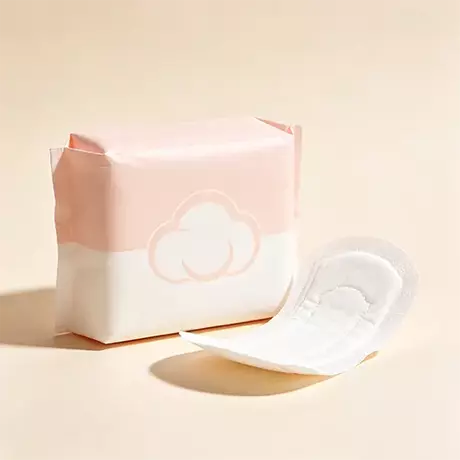
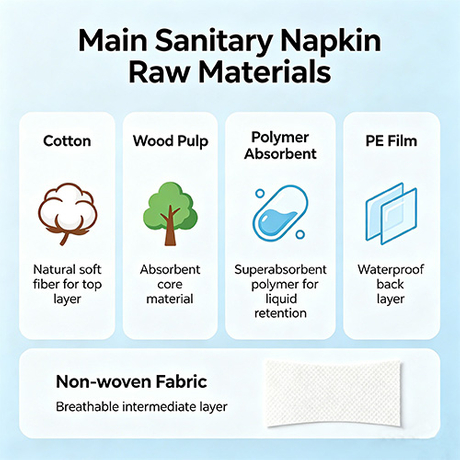
Most disposable sanitary pads consist of three functional layers: the topsheet (skin-contact layer), the absorbent core, and the backsheet (liquid barrier). Each layer's material properties—air permeability, moisture vapor transmission, and surface friction—directly impact heat retention, moisture accumulation, and skin barrier function. This guide breaks down the materials science behind each layer, evaluates their performance in hot climates, and provides evidence-based recommendations.

Figure 1: Cross-sectional diagram of a disposable sanitary pad showing the three functional layers
1. Topsheet Materials: The Skin-Contact Layer
The topsheet governs immediate tactile sensation, surface dryness, and air exchange at the skin interface. In thermography studies, topsheet material accounts for a significant portion of the total heat retention variance in sanitary pads.
1.1 Natural Cotton / Organic Cotton Topsheet
Natural cotton non-woven fabric and certified organic cotton (GOTS-certified) are frequently recommended for warm environments and sensitive skin.
✅ Advantages for Hot Weather
- Fiber architecture: Cotton's natural helical fiber structure creates interstitial air pockets that facilitate convective heat dissipation. Cotton's thermal conductivity is lower than polyester, meaning less conductive heat transfer to the skin (Morton & Hearle, 2008).
- Low friction: Cotton's friction coefficient against skin is lower than many synthetic meshes, reducing mechanical irritation and inner-thigh chafing during prolonged wear.
- Reduced chemical burden: Organic cotton is cultivated without synthetic pesticides and processed without chlorine bleach. This eliminates residual halogenated organic compounds that can trigger contact dermatitis in heat-occluded skin.
❌ Limitations
- Surface moisture retention: Standard cotton topsheets absorb fluid into the fiber lumen, which may prolong surface dampness under heavy flow. They do not deliver the rapid "strike-through" and surface dryness of perforated synthetic meshes.
- Quality variability: Lower-grade "cotton-blend" topsheets may incorporate synthetic thermoplastic binders to enhance web integrity, which can reduce air permeability significantly.
1.2 Dry Mesh (Perforated Polyester Topsheet)
Dry mesh topsheets are engineered from perforated spunbond or thermal-bonded polyester (PET) non-woven fabric.
✅ Advantages for Hot Weather
- Rapid fluid acquisition: The combination of hydrophobic PET fibers and macro-perforations enables fluid to pass through to the absorbent core within seconds, maintaining a low-rewet surface. Users perceive this as a "dry touch" even after multiple gushes.
- Low fluid retention at surface: PET has minimal moisture regain, meaning virtually no fluid is retained in the topsheet fibers themselves.
❌ Limitations
- Poor breathability: PET is hydrophobic and non-porous at the fiber level. While perforations aid liquid transport, they do not significantly enhance water vapor transmission. In a hot environment, insensible perspiration can accumulate at the skin-mesh interface.
- Mechanical irritation risk: The surface texture of thermal-bonded meshes can exhibit higher dynamic friction against moist skin, particularly at the medial thigh contact points. Prolonged wear (>4 hours) increases the risk of frictional dermatitis.
- Thermal retention: Synthetic polymers have higher thermal effusivity, contributing to a subjectively "warmer" feel in ambient temperatures above 28°C.
1.3 Bamboo Viscose (Bamboo Rayon) Topsheet
Bamboo viscose is a regenerated cellulosic fiber produced via the viscose process from bamboo pulp. It is increasingly marketed in feminine hygiene for its purported thermal and antimicrobial properties.
✅ Advantages for Hot Weather
- Superior moisture management: Bamboo viscose exhibits higher moisture regain than cotton, with a fiber surface that facilitates rapid wicking along the fiber length via capillary action. This creates a cooling sensation through evaporative heat loss.
- Thermal regulation: The cross-section of bamboo viscose fibers contains microscopic voids. Research comparing regenerated bamboo fabrics to cotton and viscose rayon using sweating manikin tests confirmed that bamboo viscose fabrics have excellent moisture and temperature management properties (van der Pol, n.d.).
- Antimicrobial properties: In vitro studies have investigated bamboo viscose for ultraviolet protective ability and antimicrobial activity. However, untreated bamboo viscose fabric was found to afford minimal antimicrobial properties on its own—enhanced antimicrobial effects typically require additional finishing treatments. The natural "bamboo kun" antimicrobial agent present in raw bamboo may not fully survive the chemical viscose processing.
- Hypoallergenic profile: The smooth fiber surface (round cross-section) reduces mechanical irritation, and the absence of lignin-based impurities in refined viscose lowers sensitization risk.
❌ Limitations
- Availability and cost: Bamboo viscose topsheets are niche in mainstream markets, typically commanding a 30–50% price premium over standard cotton or mesh alternatives.
- Absorption kinetics: While total fluid retention is high, the initial strike-through speed is slower than perforated mesh due to the absence of macro-perforations. This may result in temporary surface pooling under sudden heavy flow.
- Processing transparency: Not all "bamboo" labeled products use viscose; some are conventional rayon with minimal bamboo content. Look for OEKO-TEX or FSC certification for verification.
- Manufacturing concerns: The viscose process involves chemicals including caustic soda and carbon disulfide. More sustainable closed-loop production methods exist but are not universal.
2. Absorbent Core Materials: The Thermal Mass Layer
The absorbent core constitutes the bulk of the pad and is the primary thermal reservoir. Core thickness correlates directly with heat insulation and moisture retention time.
2.1 Fluff Pulp + SAP (Superabsorbent Polymer) Core
The industry standard core consists of air-laid wood fluff pulp interspersed with sodium polyacrylate SAP granules. SAP can absorb 30–60 times its weight in saline solution (Buchholz & Graham, 1998).
Hot weather considerations:
- Ultra-thin core designs (2–4 mm total pad thickness) reduce the thermal insulation effect. Thicker pads create extra insulation and trapped heat—research on thermal comfort behavior of sanitary napkins has shown that core composition significantly impacts thermal resistance (Mahalakshmi & Maheshwari, 2024).
- SAP concentration must be balanced: higher SAP ratios improve fluid locking but can create a "gel block" effect that reduces lateral wicking, increasing local saturation and heat retention.
2.2 All-Natural Pulp Cores (Zero Synthetic SAP)
Some organic brands use 100% wood pulp or cotton fluff without synthetic SAP.
Hot weather considerations:
- Higher breathability: Cellulose-only cores have higher air permeability and faster moisture vapor transmission.
- Trade-off in capacity: Without SAP, fluid retention under pressure is significantly higher. Leakage risk increases under moderate-to-heavy flow, necessitating more frequent changes and potentially offsetting the comfort benefit.
3. Backsheet Materials: The Overlooked Suffocation Layer
The backsheet is the liquid-impermeable barrier between the absorbent core and underwear. It is frequently the most occlusive layer and a major contributor to the "greenhouse effect" in hot weather.
3.1 Non-Breathable PE (Polyethylene) Film
Standard low-density polyethylene film provides complete liquid barrier but has negligible water vapor transmission.
Impact in heat: In ambient temperatures above 30°C, the moisture vapor transmission rate through non-breathable PE is extremely low. Trapped perspiration raises relative humidity at the skin interface to over 90%, creating ideal conditions for yeast proliferation and heat rash.
3.2 Microporous Breathable PE Backsheet
Microporous films are created by stretching calcium carbonate-filled PE to create interconnected micropores. These pores are large enough to allow water vapor molecules to pass but small enough to block liquid water and bacteria.
Performance metrics:
- Water vapor transmission rate is 10–40× higher than non-breathable PE
- Liquid hydrostatic resistance remains adequate for menstrual fluid barrier
4. Evidence-Based Comparison

Figure 2: Material performance comparison across key comfort metrics
| Material | Air Permeability | Surface Dryness | Skin Compatibility | Hot Weather Suitability |
|---|---|---|---|---|
| Organic Cotton Topsheet | ★★★★☆ | ★★☆☆☆ | ★★★★★ | Very good (light–medium flow, sensitive skin) |
| Dry Mesh Topsheet | ★★★☆☆ | ★★★★★ | ★★★☆☆ | Good (medium–heavy flow, air-conditioned settings) |
| Bamboo Viscose Topsheet | ★★★★★ | ★★★☆☆ | ★★★★★ | Excellent (humid tropical climates, all flow types) |
| Non-Breathable PE Backsheet | ★☆☆☆☆ | — | ★★☆☆☆ | Not recommended for heat |
| Microporous Breathable Backsheet | ★★★★☆ | — | ★★★★☆ | Recommended minimum standard |
Ratings based on composite assessment of published textile science data, moisture vapor transmission measurements, and dermatological wear trials.
5. Dermatologist-Backed Buying Principles for Hot Weather
- Prioritize the backsheet first. Even the most breathable cotton topsheet will feel stifling if paired with a non-breathable plastic base. Look for packaging terms: "breathable backsheet," "microporous film," or "vapor-permeable barrier."
- Eliminate fragrance. Fragrance chemicals (phthalates, synthetic musks, aldehydes) interact with sweat and sebum at elevated skin temperatures, increasing the risk of allergic contact dermatitis. Clinical reviews of fragrance contact allergy have documented that scented products are a significant source of skin sensitization in the general population (Johansen, 2003). The American College of Obstetricians and Gynecologists recommends fragrance-free products for individuals with recurrent vulvovaginal irritation.
- Match thickness to flow, then minimize. Select the thinnest pad adequate for your flow. Extra thickness adds thermal insulation without benefit.
- Increase change frequency in heat. Bacterial growth accelerates with temperature. In hot weather, change every 3–4 hours regardless of saturation.
- Match topsheet to skin phenotype:
- Sensitive/atopic skin: Organic cotton or bamboo viscose
- Heavy flow + non-sensitive skin: Dry mesh with breathable backsheet
- Humid tropical climate: Bamboo viscose (superior moisture wicking)
6. Frequently Asked Questions
Cooling pads incorporate menthol, methyl lactate, or encapsulated phase-change materials to create a transient cooling sensation. However:
- The effect is temporary (typically 15–45 minutes) and does not address underlying material breathability.
- Menthol can trigger contact urticaria or cold-induced vasodilation in sensitive individuals (Greaves & Khalil, 2011).
- Phase-change materials may increase pad thickness and thermal mass.
No single material is optimal for all flow phases. A mixed strategy is recommended:
- Days 1–2 (heavy flow): Dry mesh topsheet + breathable backsheet + ultra-thin SAP core
- Days 3–4 (medium flow): Bamboo viscose topsheet + breathable backsheet
- Days 5+ (light flow/spotting): Organic cotton liner or reusable cloth pad (100% cotton flannel) for maximum breathability
Reusable pads made from organic cotton flannel or bamboo fleece can offer superior air permeability (no plastic backsheet). However:
- They lack SAP, so fluid retention under pressure is higher—leakage risk is significant on heavy days.
- They require immediate washing to prevent bacterial colonization in hot, humid conditions.
- Best suited as backup to menstrual cups or on very light days.
The microenvironment (temperature, humidity, pH) is a stronger predictor than material alone. However, non-breathable backsheets that trap heat and moisture can elevate local humidity, which favors Candida albicans growth. Research on recurrent vulvovaginal candidiasis has established that warm, moist environments contribute to fungal proliferation (Sobel, 2016). If you experience recurrent vulvovaginal candidiasis, switching to a breathable backsheet and cotton/bamboo topsheet is a reasonable first-line environmental modification.
7. Conclusion
There is no universally "perfect" sanitary pad material for hot weather. The optimal choice is a function of flow volume, ambient humidity, skin sensitivity, and wear duration:
| User Profile | Recommended Combination |
|---|---|
| Sensitive skin / humid tropical climate | Organic cotton or bamboo viscose topsheet + microporous breathable backsheet |
| Medium–heavy flow / dry-surface priority | Dry mesh topsheet + microporous breathable backsheet |
| Maximum breathability, light flow | 100% cotton reusable liner or ultra-thin disposable with breathable backsheet |
Regardless of material selection, frequency of pad changes remains the single most effective intervention to minimize thermal discomfort, bacterial overgrowth, and odor during hot-weather menstruation. In ambient temperatures above 30°C, adhere to a maximum 4-hour wear interval, and consider showering or gentle perineal cleansing at each change to restore skin barrier integrity.