Home
Home | About Us | Advantages | Blogs | Contact Us


- All
- Product Name
- Product Keyword
- Product Model
- Product Summary
- Product Description
- Multi Field Search
Views: 0 Author: Site Editor Publish Time: 2026-09-09 Origin: Site


Balancing end-user comfort with manufacturing viability remains a primary business challenge for hygiene product brands. You want ultimate softness and hypoallergenic properties for consumers. Yet, you also need high tensile strength and a manageable cost per unit for production. This reality of hygiene manufacturing leaves little room for error on the factory floor. A slight variation in fabric Grams per Square Meter (GSM) or tensile strength can cause severe issues. It often leads to sudden machine downtime, increased material waste, or outright product failure. To avoid these costly pitfalls, you need a strict, objective evaluation framework. This guide serves as a technical and commercial blueprint for procurement teams and production engineers. We will explore how to source reliable raw materials effectively. You will learn to match fabric technologies to specific components and navigate critical evaluation criteria. Let us dive into the details of selecting the ideal materials to optimize your production lines.
Selecting the right nonwoven fabric for diapers and sanitary pads requires matching specific fabric technologies (e.g., Spunbond, Air-through) to their exact function (topsheet, backsheet, or core wrap).
Evaluating tensile strength and elongation is just as critical as softness, as these metrics dictate machine run-ability and prevent line jams.
Compliance and supply chain transparency (e.g., OEKO-TEX certification, trace petro-chemicals vs. sustainable fibers) are non-negotiable for modern consumer safety standards.
Supplier vetting should mandate technical data sheets (TDS) and pilot-run sample testing before committing to high-volume minimum order quantities (MOQs).
Modern hygiene products rely on advanced polymer extrusion and bonding techniques. You must understand how these manufacturing processes dictate material performance. Each method yields unique physical properties tailored for specific product layers.
The spunbond process involves melting thermoplastic polymers and extruding them through fine spinnerets. This creates continuous filaments. These filaments lay down randomly on a moving conveyor belt. Heated rollers then compress and bond the web together. This process yields high tensile strength at a remarkably low cost. Best use cases include standard backsheets, core wrapping, and leg cuffs. SS nonwoven utilizes two consecutive spinning beams. It offers vastly improved web uniformity, better coverage, and a smoother surface profile compared to single-beam materials.
SMS fabrics deliver exceptional multi-layer barrier properties. The manufacturing line sandwiches a delicate meltblown layer between two robust spunbond layers. The meltblown center consists of ultra-fine microfibers. It blocks liquid penetration while allowing air vapor to pass freely. You need this critical barrier for highly hydrophobic components. Anti-leak 3D leg guards rely heavily on SMS structures to contain fluids under pressure.
This process prioritizes extreme comfort. Heated air blows directly through the fiber web during the bonding phase. The air gently melts specific bicomponent fibers without crushing the overall structure. This bonding process yields high loft and exceptional softness. It serves as the premium standard for topsheet materials in sensitive skin applications. Brands often specify it for premium newborn lines or ultra-soft sanitary pads.
Spunlace technology uses high-pressure water jets to entangle staple fibers mechanically. It uses no thermal binders. Manufacturers predominantly use it for wet wipes and premium sanitary pad topsheets. It costs slightly more than thermal-bonded options. However, it delivers unique fluid handling capabilities and a textile-like drape.
A successful hygiene product functions as a cohesive system. You cannot use the same hygiene fabric for every layer. Each component demands precise physical and chemical characteristics.
The topsheet sits directly against the consumer's skin. Requirements include strong hydrophilic properties for rapid liquid strike-through. You also need ultra-softness and exceptionally low rewet values to keep the skin dry. Recommended materials include hydrophilic air-through fabrics or premium hydrophilic spunbond nonwoven. The topsheet material must facilitate fluid transfer immediately upon contact.
The ADL rests immediately beneath the topsheet. Requirements focus on a high void volume structure. It must quickly disperse sudden fluid insults away from the topsheet. It then spreads the fluid evenly across the underlying core. Without an effective ADL, the product suffers from localized flooding and immediate leakage.
The core wrap envelops the absorbent center. Requirements demand excellent structural integrity. The wrap must prevent super absorbent polymer (SAP) gel migration. It stops dry particles from escaping during transit and prevents wet gel leakage during use. It must achieve this without impeding fluid absorption. Recommended materials include SS configurations or lightweight SMS.
These exterior components form the final defense against leaks. Requirements dictate a strictly hydrophobic, breathable barrier. They prevent liquid leakage onto clothing while allowing body heat and vapor transmission. This breathability prevents skin irritation and discomfort.
Hygiene Component | Primary Function | Recommended Material | Key Property Requirement |
|---|---|---|---|
Topsheet | Skin contact & fluid entry | Air-Through / Hydrophilic Spunbond | Ultra-soft, rapid strike-through |
ADL | Fluid distribution | High-loft Carded / specialized Spunbond | High void volume, quick dispersion |
Core Wrap | SAP containment | SS / Lightweight SMS | High tensile strength, porous |
Leg Cuffs | Leak prevention | Hydrophobic SMS | Liquid barrier, skin-friendly |
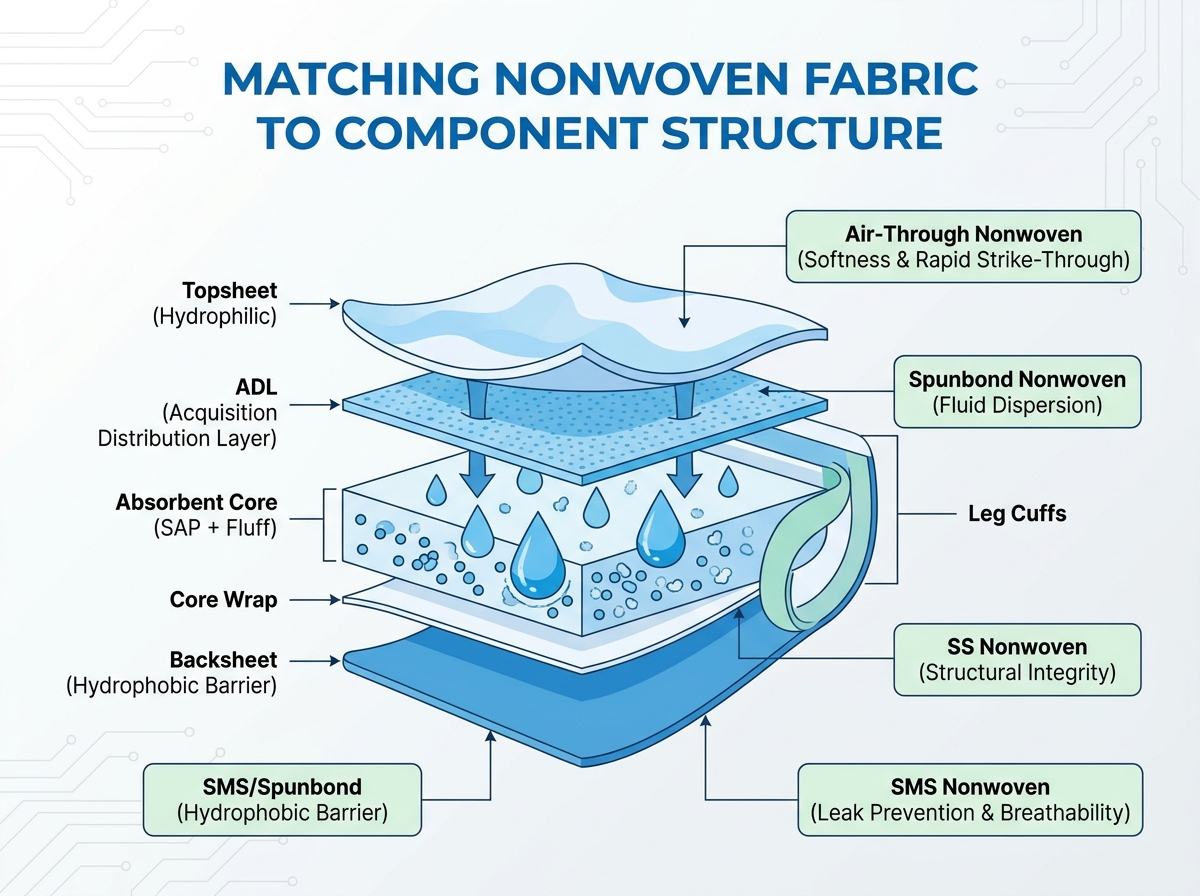
Selecting nonwoven fabric for diapers requires rigorous laboratory testing. Procurement teams must move beyond simple cost-per-ton metrics. You must evaluate these five technical criteria to ensure continuous factory output.
Fluid Management Metrics: Evaluate strike-through time meticulously. This measures the exact speed of liquid absorption. You must also measure rewet rates. Rewet indicates the amount of moisture returning to the surface under applied body pressure.
Mechanical Integrity (Machine Run-ability): Assess both cross-direction (CD) and machine-direction (MD) tensile strength. High-speed manufacturing lines apply intense mechanical tension. Weak fabric snaps quickly. This causes expensive production line downtime and high scrap rates.
Safety and Biocompatibility: Consumer safety standards remain non-negotiable. Demand verifiable testing for heavy metals and volatile organic compounds (VOCs). Check for skin sensitization risks. Rely on established frameworks like ISO 10993 or OEKO-TEX Standard 100.
Adhesive Compatibility: You construct diapers using complex hot melt adhesive patterns. Ensure the fabric's surface energy bonds reliably with these standard glues. Poor adhesive compatibility leads to structural delamination during consumer use.
Sustainability vs. Scalability: Weigh the commercial viability of traditional petrochemical-based polymers (PP/PE). Compare them against emerging biodegradable or PLA nonwovens. Note the current limitations regarding reduced shelf-life, supply bottlenecks, and higher material costs.
Evaluation Metric | Test Method Standard | Target Impact Area |
|---|---|---|
MD Tensile Strength | ASTM D5035 | Prevents web breaks during production |
Liquid Strike-Through | EDANA 150.3 | Ensures rapid skin dryness |
Wetback / Rewet | EDANA 151.3 | Maintains comfort under pressure |
VOC Emissions | ISO 16000 | Ensures consumer safety & compliance |
Ignoring technical specifications leads directly to factory floor disasters. Production engineers face severe operational hurdles when procurement sources substandard materials. Understanding these risks helps you justify stricter quality controls.
Poorly bonded fibers shed easily during high-speed production. They accumulate quickly across the manufacturing line. These loose fibers clog delicate machinery sensors and vision inspection cameras. They also create an unappealing, messy end product. Excessive linting requires frequent maintenance stops to clean the equipment.
Variations in roll winding disrupt your continuous process. Uneven fabric thickness (GSM) creates similar structural headaches. These issues require constant machine recalibration by operators. The web will track poorly through the rollers. Tension inconsistencies ultimately destroy your yield rates and increase raw material waste.
Fabrics sometimes possess inconsistent polymer melting points. They may burn, warp, or shrink unexpectedly. This damage happens frequently during ultrasonic welding phases. It also occurs during hot-melt adhesive applications. A burned web compromises the barrier properties and ruins the aesthetic appeal.
Low-grade plastic resins often off-gas significantly. This leads to foul smells upon opening the packaging. Such chemical residues trigger immediate consumer complaints. They ruin brand reputation and can prompt expensive regulatory product recalls. You must demand high-purity resins to avoid odor issues.
Finding a reliable supplier requires a methodical auditing process. You cannot risk your production schedule on unverified promises. Follow these procedural steps to qualify potential manufacturing partners effectively.
Requesting the Right Documentation: Never buy off a glossy marketing brochure. Mandate a comprehensive Technical Data Sheet (TDS) for every SKU. Ask for the Material Safety Data Sheet (MSDS). Require historical batch-testing certificates to verify their long-term manufacturing consistency.
The Pilot Run Protocol: Always order a localized sample roll first. Test it on your specific manufacturing equipment. Run the material at your standard operating speeds. Do this rigorous testing before signing any annual purchasing contracts.
Assessing Quality Control (QC) Infrastructure: Look for modern suppliers operating cleanroom-style facilities. They should utilize in-line automated vision inspection systems. These cameras catch tiny fabric defects, holes, or hard spots immediately. Good QC stops bad rolls before they ever reach the shipping dock.
Supply Chain Resilience: Evaluate their overall production capacity thoroughly. Check their raw material sourcing stability. Review their historical lead times during crisis periods. These checks protect your assembly lines against sudden global supply shocks.
Selecting nonwoven fabric for diapers is a complex engineering decision. It extends far beyond a basic procurement checklist. You must balance consumer softness with aggressive manufacturing demands. Upfront due diligence pays off immensely. You must carefully match GSM, tensile strength, and hydrophobic treatments to specific product tiers. Doing so prevents costly manufacturing failures and protects your brand reputation. Establish clear evaluation criteria for strike-through rates and mechanical integrity. Build robust supplier auditing protocols before committing to large volumes. Are you ready to optimize your hygiene product manufacturing? Take action today. Request a technical consultation with your engineering team. Ask your prospective suppliers for a comprehensive sample kit and a detailed TDS for your next production run.
A: The standard range typically falls between 12 to 18 GSM. This specific weight balances several crucial factors perfectly. It provides necessary softness for sensitive infant skin. It ensures rapid liquid penetration into the absorbent core below. Finally, it keeps the overall material cost manageable for high-volume manufacturing.
A: SMS includes a specialized meltblown layer sandwiched between two spunbond layers. This middle layer provides essential liquid barrier properties to stop leaks. Standard spunbond lacks this meltblown barrier entirely. Manufacturers use standard spunbond primarily for basic structural support, core wrapping, and overall breathability.
A: Yes, they can be fully biodegradable. You can utilize natural materials like bamboo, organic cotton, or polylactic acid (PLA). However, you must carefully weigh the trade-offs. Biodegradable options often reduce manufacturing speed. They carry a higher material cost and face frequent supply availability fluctuations.
A: The acquisition distribution layer (ADL) and core wrap must disperse fluid evenly. They act as the fluid delivery system. If the fabric restricts fluid flow, the Super Absorbent Polymer (SAP) cannot swell efficiently. Uneven absorption quickly leads to localized flooding and subsequent product leakage.


