


From baby diapers to medical disinfectant wipes, a material that blends natural wood pulp fibers with high-pressure water-jet entanglement is quietly reshaping the hygiene products we use every day. Here is what manufacturers and procurement teams actually need to know.
What Is Wood Pulp Spunlace Nonwoven?
Wood pulp spunlace nonwoven is a fabric made by entangling natural wood pulp fibers with synthetic or regenerated cellulose fibers (such as polyester, viscose, or Lyocell) using a high-pressure water-jet process called spunlacing.
Unlike thermal-bonded or chemically bonded nonwovens, spunlacing uses no adhesives. Thousands of ultra-fine water needles pierce the fiber web at high pressure, causing the fibers to tangle and lock together into a cohesive sheet. The result is a material that behaves like paper in absorbency but feels like cloth in softness.
Four Core Advantages That Matter
| Property | How It Performs | End-User Benefit |
|---|---|---|
| Absorbency | Wood pulp fibers have a natural porous structure; liquid absorption reaches 600–1,600% of fabric weight, significantly outperforming synthetic-only alternatives | Instant dryness, reduced risk of diaper rash or skin irritation |
| Softness | The water-jet process creates a suede-like surface with low friction coefficient | Gentle enough for newborn skin and sensitive areas |
| Wet Strength | Three-dimensional fiber entanglement maintains integrity even when saturated | No clumping, no breakage, virtually lint-free during use |
| Eco-Profile | Wood pulp is sourced from renewable timber; some grades are industrially compostable | Lower carbon footprint vs. all-synthetic alternatives |
Where It Shows Up: From Surface Wipes to Absorbent Cores
Surface Cleaning: The Wipe Workhorse
This is the most mature application area. The material's high absorbency and chemical compatibility make it the default substrate for premium wet wipes.
| Product Type | Key Requirement | Why Wood Pulp Spunlace Fits |
|---|---|---|
| Baby wipes | Safety, low allergenicity | High natural-fiber content; no adhesive residue |
| Feminine hygiene wipes | Lint-free, skin-friendly | Structural integrity prevents fiber shedding |
| Medical disinfectant wipes | High liquid loading, chemical stability | Porous structure distributes disinfectant evenly |
| Facial cleansing wipes | Soft texture, no pilling | Suede-like surface reduces mechanical skin stress |
Absorbent Cores: The Real Growth Engine
Over the past five years, the most significant shift has been the migration of wood pulp spunlace from surface layers into the absorbent core of diapers and sanitary napkins. This is where the material is driving real product differentiation.
Baby Diapers: From Fluff-Mix Cores to Composite Cores
Traditional diaper cores are a loose blend of fluff pulp and superabsorbent polymer (SAP). The problem is well documented: after the first wetting, the core breaks apart, SAP migrates, and the diaper becomes lumpy and leaky.
Several leading brands have moved to a composite core architecture where a wood pulp spunlace nonwoven acts as the structural scaffold for SAP. The benefits are concrete:
- Zero core breakage: The entangled fiber network locks SAP in place even after multiple wettings
- Slimmer profile: The composite structure allows for a more compact pad design without sacrificing absorbency
- 3D channel design compatibility: The nonwoven substrate can be embossed with fluid-distribution channels that spread liquid laterally before locking it away
- Improved comfort design: Lower rewet rates and better breathability are engineered to reduce skin moisture exposure during use
Products marketed with "wood pulp spunlace structured core" now list gentle dryness, massive absorbency, and zero rewet as primary selling points. This is not marketing fluff — it is a direct consequence of the material's structural properties.
Sanitary Napkins: Solving the Dust Problem
Traditional sanitary napkin cores fall into two camps: fluff pulp (cheap but dusty) or airlaid paper (less dusty but poorer liquid spread). Wood pulp spunlace cores offer a third path:
- Virtually dust-free: Fibers are physically locked by water jets; no loose fibers to shed
- Superior wicking: Liquid travels along the fiber network rather than pooling in one spot
- Shape retention: The core stays flat and in place during movement, eliminating the "bunched-up" feeling
Market Context: The Numbers Behind the Trend
Wood pulp spunlace sits within the broader spunlace nonwoven segment. While industry statistics do not break out wood pulp as a standalone category (it is grouped under "other fibers"), the overall spunlace market trajectory provides the necessary context.
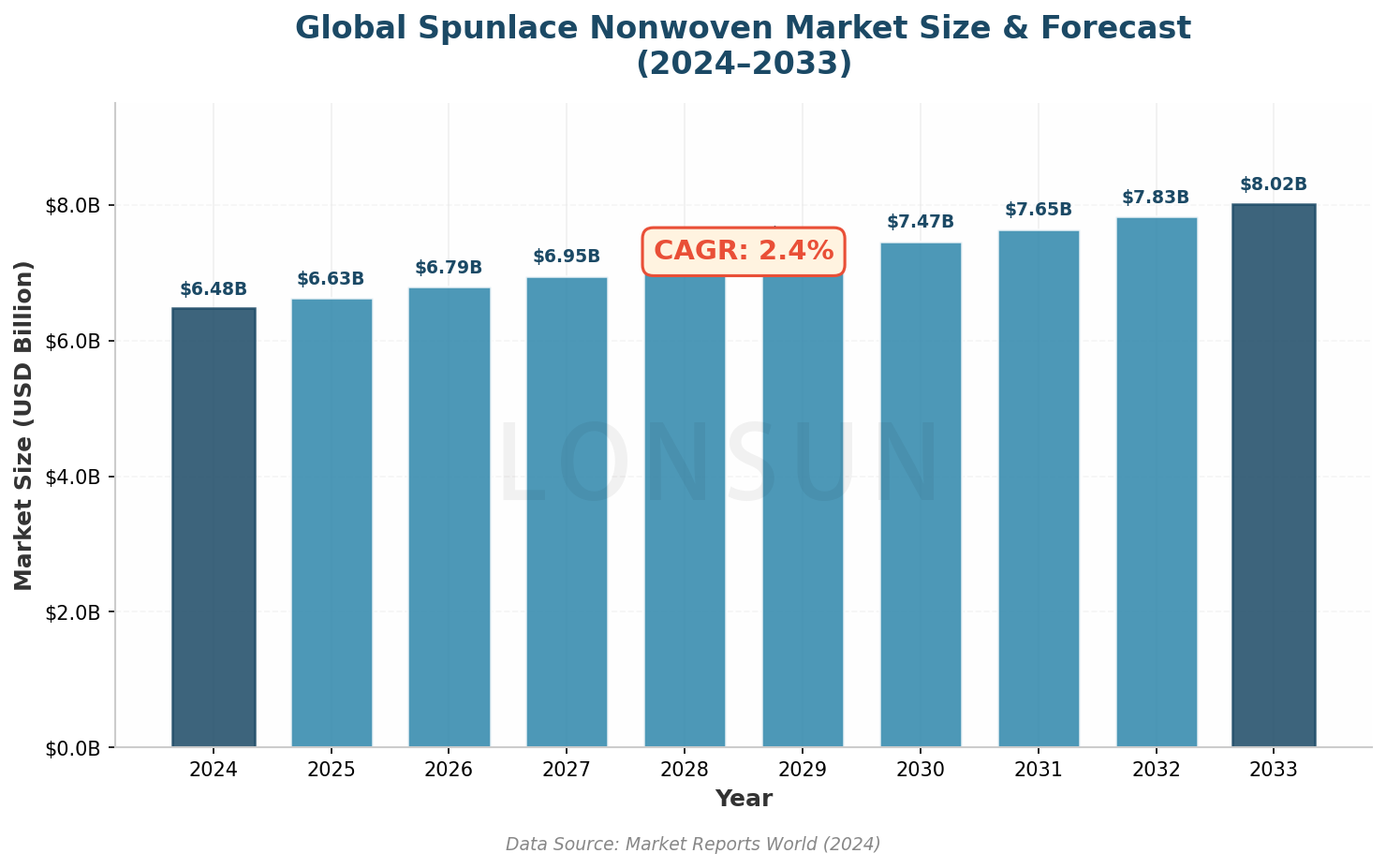
The global spunlace nonwoven market was valued at approximately $6.48 billion in 2024 and is projected to reach $8.02 billion by 2033, reflecting a compound annual growth rate of 2.4%. The more dynamic sub-segment is wet wipes, where spunlace consumption is growing at roughly 9.5% annually — a rate that outpaces the overall nonwoven average.
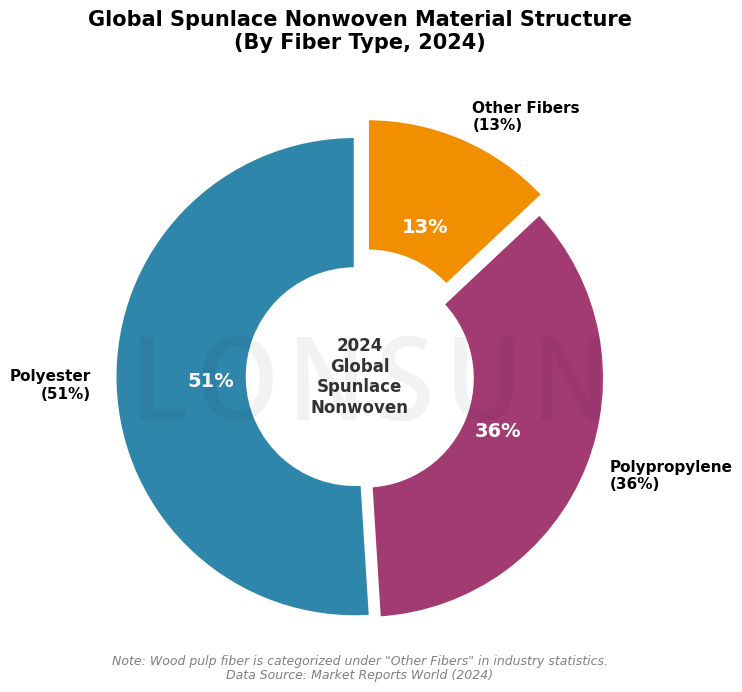
Polyester dominates at 51%, polypropylene holds 36%, and all remaining fibers — including wood pulp, viscose, and Lyocell — account for the remaining 13%. Within that 13%, wood pulp spunlace is the fastest-growing fiber type, driven by demand for biodegradable and high-absorbency applications.
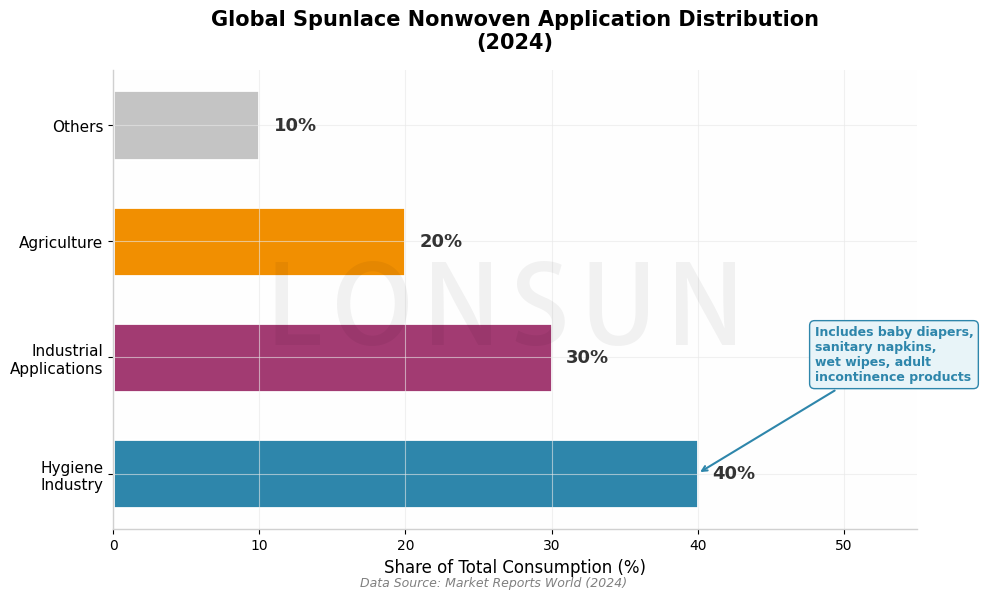
The hygiene industry consumes 40% of global spunlace output — roughly 720,000 tonnes annually. This single end-use segment is the primary demand driver for wood pulp spunlace innovation, particularly as brands shift from surface-only applications to absorbent core integration.
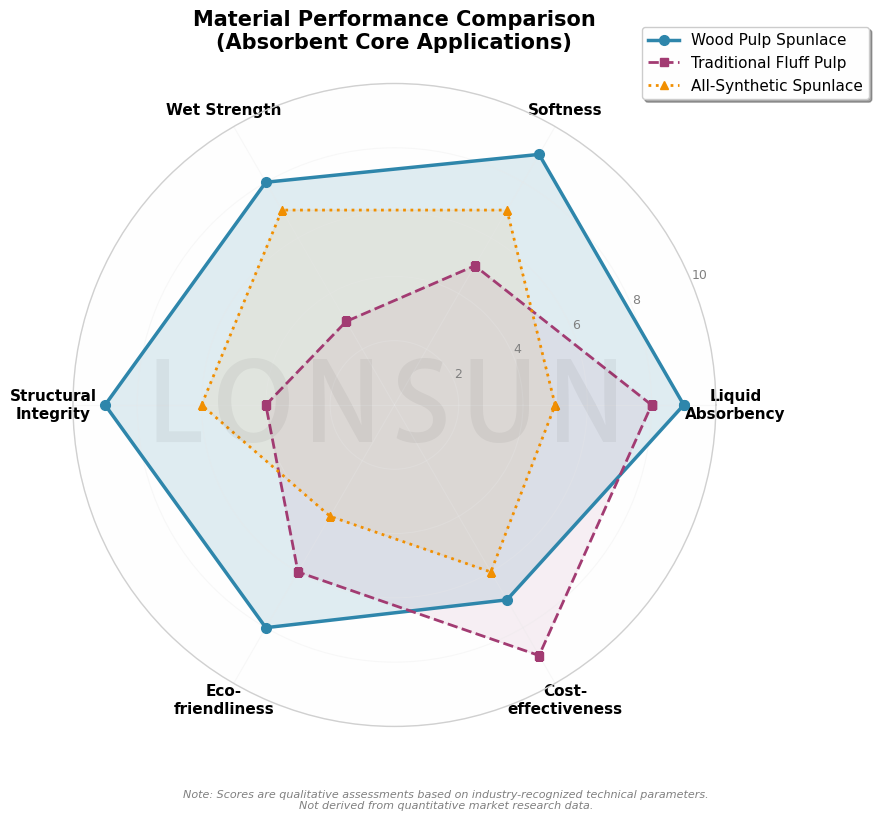
The radar chart above illustrates why wood pulp spunlace is gaining ground against incumbent materials. It outperforms traditional fluff pulp on structural integrity, wet strength, and eco-friendliness. Against all-synthetic spunlace, it wins on absorbency and biodegradability while remaining cost-competitive.
Three Trends Shaping the Next Five Years
1. Premiumization of Everyday Hygiene
Consumers are no longer satisfied with "good enough." A diaper that merely contains liquid is baseline; parents now expect thermal comfort, skin health, and leak-proof performance simultaneously. Wood pulp spunlace composite cores address all three, which is why they are migrating from premium SKUs to mid-tier product lines.
2. Regulatory Pressure on Plastic Content
The EU Single-Use Plastics Directive and China's dual-carbon targets are forcing material substitutions. Wood pulp spunlace, with its renewable feedstock and compostable end-of-life pathway, offers a credible alternative to polypropylene-based cores. Some suppliers reference compostability standards such as EN 13432 for wood pulp-dominant grades.
3. Equipment Scale-Up Driving Cost Parity
Five years ago, wood pulp spunlace was confined to high-end products due to line speed and yield constraints. Domestic equipment manufacturers in China and Europe have since closed the gap. As production scales, As production scales, wood pulp spunlace is becoming cost-competitive with traditional core materials — making mass-market adoption economically viable.
Procurement Quick-Check: What to Look For
If you are evaluating wood pulp spunlace for product development or supplier qualification, here are the practical checkpoints:
| Check | Good Indicator | Red Flag |
|---|---|---|
| Hand feel | Suede-like softness with perceptible thickness | Stiff boardy feel or excessive slipperiness (high synthetic ratio) |
| Wet integrity | Holds shape when saturated; resists tearing | Disintegrates or sheds fibers upon light pulling |
| Burn test | Burns rapidly, fine ash, paper-like odor | Slow burning, plastic bead formation, acrid smell |
| Labeling | Explicit "wood pulp spunlace nonwoven" or "composite core" stated | Vague "nonwoven" claim with no fiber composition detail |
| Basis weight | 35–80 gsm for wipes; 35–60 gsm for core wraps | Significantly outside range without technical justification |
Bottom Line
Wood pulp spunlace nonwoven is not a niche material anymore. It has moved from the surface of wet wipes to the structural heart of diapers and sanitary products, solving real engineering problems — core breakage, dust shedding, and thermal discomfort — that synthetic alternatives struggle with.
The growth is underpinned by three solid fundamentals: consumer demand for better performance, regulatory pressure for lower plastic content, and manufacturing scale that is finally making the economics work. For procurement teams and product developers, it is now a material worth evaluating seriously rather than treating as a premium curiosity.
About the data: Market figures cited in this article are derived from publicly available industry reports. Wood pulp spunlace is not tracked as a standalone category in standard market research; where specific breakdowns are unavailable, we have noted this explicitly. Performance comparisons are based on published technical specifications from major manufacturers and are intended as directional guidance rather than absolute benchmarks.


